The White House’s Secret AI Cybersecurity Framework: What Tech Giants Know That You Don’t
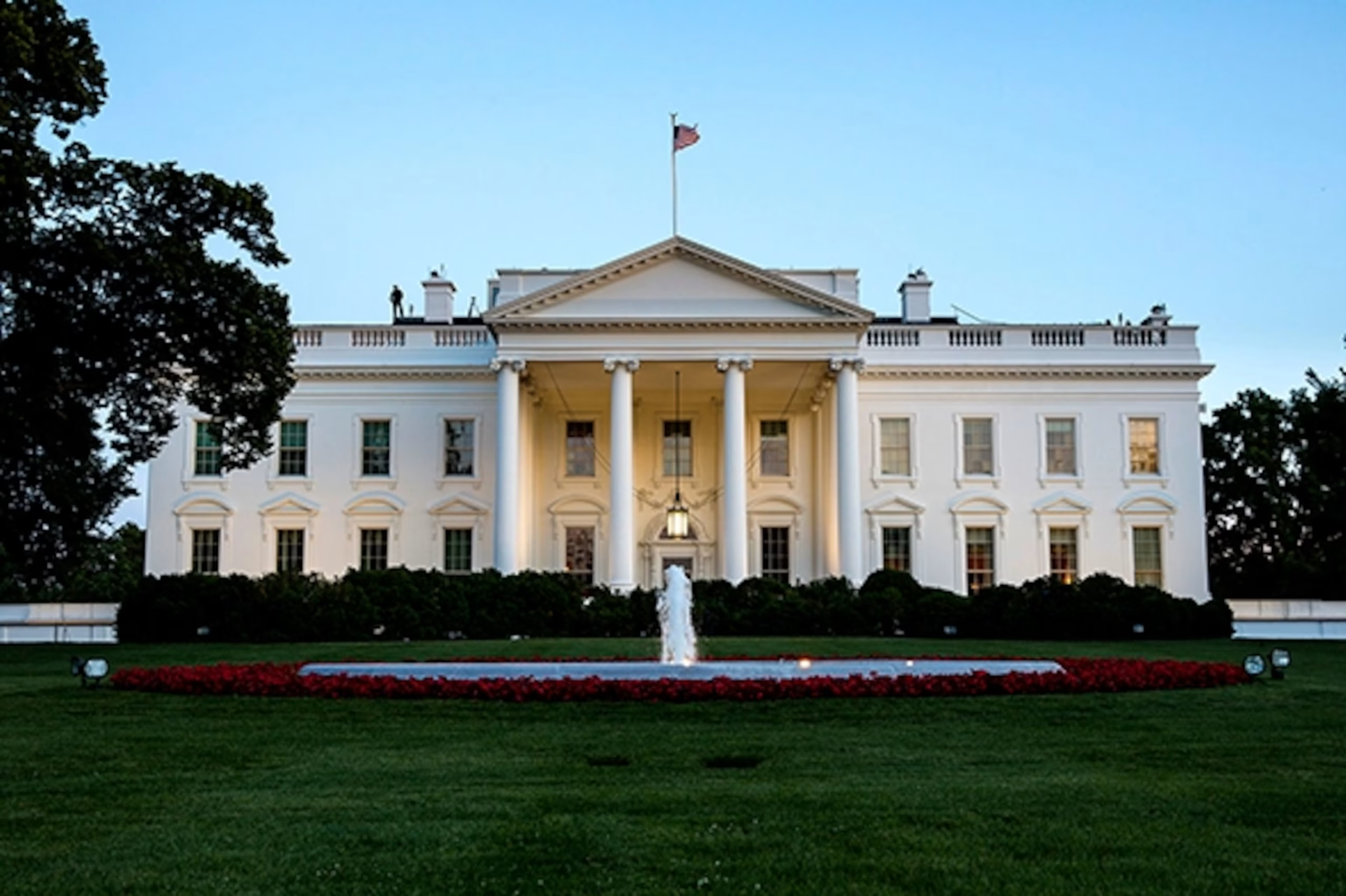
The White House recently built a voluntary cybersecurity framework for advanced AI models, but it shared the details only with tech giants like OpenAI and Google behind closed doors. This secrecy has sparked serious concerns about transparency, fair competition, and who truly controls the future of artificial intelligence.
Table of Contents
- What Is the Voluntary AI Cybersecurity Framework?
- The 30-Day Pre-Release Window
- Who Gets Access? The NSA and Federal Agencies
- Open-Weight Models: The Exemption That Shapes the Playing Field
- The Closed-Door Meetings: Why Secrecy Worries Observers
- The Hidden Licensing Fear: Are We Building a Tech Oligopoly?
- What This Means for Startups and Open Source Developers
- The Bigger Picture: National Security vs. Innovation
- Conclusion
What Is the Voluntary AI Cybersecurity Framework?
On June 2, 2026, President Trump signed an executive order titled “Promoting Advanced Artificial Intelligence Innovation and Security.” This order created a new pathway for the federal government to engage with the most powerful AI systems before they reach the public. The framework targets what officials now call “covered frontier models”—AI systems that show advanced capabilities in cybersecurity tasks like finding and exploiting software weaknesses.
The order directs multiple agencies to work together on this initiative. The Treasury Department, the National Security Agency (NSA), and the Cybersecurity and Infrastructure Security Agency (CISA) must build a classified benchmarking process. This process will determine which models cross the threshold into “covered frontier model” territory. The NSA Director holds the final say on these designations, consulting with the National Cyber Director and other key officials.
Importantly, the framework stays voluntary. The executive order explicitly states that it does not create any mandatory licensing, preclearance, or permitting requirement for AI developers. Companies can choose whether to participate. However, industry insiders note that opting out carries real risks—especially when national security agencies might view non-participation with suspicion.
How the Framework Differs From Past AI Policy
This executive order represents the third major AI directive from Trump’s second term. Earlier orders focused on removing regulatory barriers and asserting federal preemption over state AI laws. This new order signals a major shift—acknowledging that advanced AI capabilities present national security concerns that demand coordinated government action. The administration now recognizes that simply leaving frontier AI to market forces may expose critical infrastructure to unacceptable risks.
The 30-Day Pre-Release Window
One of the most concrete elements of this framework is the 30-day pre-release access window. Developers who choose to participate can give federal agencies early access to their covered frontier models for up to 30 days before releasing them to other trusted partners or the general public.
This 30-day period matters because it gives government testers time to evaluate how a model might perform in real-world cyber scenarios. Can the AI find critical vulnerabilities in software? Could it help attackers breach systems? Does it pose risks to critical infrastructure like power grids or financial networks? These questions drive the testing agenda.
The 30-day window actually represents a compromise. Earlier drafts of the executive order reportedly proposed a much longer 90-day review period. Tech companies pushed back hard against that timeline, arguing that it would slow innovation and give competitors—both domestic and foreign—an unfair advantage. The final 30-day period reflects a middle ground between national security hawks who want thorough vetting and industry advocates who fear regulatory chokeholds.
During this window, participating companies must share their models under strict confidentiality, cybersecurity, insider-risk, and intellectual property protections. The government promises to guard trade secrets and proprietary information, but the exact safeguards remain classified—another layer of opacity that worries independent researchers.
What Happens During the 30 Days?
Federal agencies use this window to run classified benchmarks that assess advanced cyber capabilities. The NSA leads these evaluations, looking at whether a model can discover, validate, or exploit software weaknesses at scale. The government may also test whether the model could assist with defensive cybersecurity tasks, such as identifying vulnerabilities in critical infrastructure systems before malicious actors find them.
Who Gets Access? The NSA and Federal Agencies
The National Security Agency sits at the center of this framework. The executive order tasks the NSA Director with making the final determination about which models qualify as covered frontier models. This gives America’s premier signals intelligence organization a direct role in evaluating commercial AI systems before they hit the market.
The NSA will conduct classified benchmarking to assess advanced cyber capabilities. This means the criteria for evaluation, the specific tests performed, and even the thresholds that trigger coverage all remain secret. Companies developing frontier models must essentially guess whether their systems will cross the line—or engage with the government early to find out.
Beyond the NSA, several other agencies play key roles. CISA will expand cybersecurity services and push AI-enabled defensive tools to federal agencies, state governments, and critical infrastructure operators. The Treasury Department leads a new AI cybersecurity clearinghouse that coordinates vulnerability discovery, software testing, and patch distribution across the tech industry and critical infrastructure sectors.
The Attorney General also received new marching orders. The executive order directs the Justice Department to prioritize enforcement against criminals who use AI to break into computer systems, steal data, or facilitate cybercrime. This targets bad actors who weaponize AI capabilities for illegal purposes, using existing laws like the Computer Fraud and Abuse Act.
The AI Cybersecurity Clearinghouse
The Treasury Department, in coordination with the NSA and CISA, must form an AI cybersecurity clearinghouse within 30 days of the executive order. This clearinghouse will centralize vulnerability scanning, discovery, and patch distribution across critical infrastructure. Rural hospitals, community banks, and local utilities all stand to benefit—signaling that policymakers understand the security gap between large federal agencies and smaller critical infrastructure operators.
Open-Weight Models: The Exemption That Shapes the Playing Field
Perhaps the most consequential carve-out in this framework concerns open-weight models. The White House decided to exempt open-weight AI systems from the voluntary pre-release testing requirements. These models—made freely available for download, modification, and deployment by anyone—will not face the same government scrutiny as their closed, proprietary counterparts.
This exemption has drawn both praise and criticism. Supporters argue that open-weight models drive innovation, democratize access to powerful AI tools, and prevent a handful of large companies from controlling the technology. They point out that open models from companies like Meta, Nvidia, and various open-source projects have accelerated research and enabled startups to build applications without paying hefty API fees.
However, critics worry that this creates a glaring loophole. If a truly dangerous AI model gets released as open-weight software, the government would have no pre-release visibility into its capabilities. Bad actors could download, modify, and deploy such models without any oversight. The recent DeepSeek R-1 incident—where researchers found cybersecurity flaws exposing sensitive data—shows that open models can carry real risks.
The exemption also creates a strange competitive dynamic. Closed-model developers like OpenAI, Anthropic, and Google must navigate government review, while open-weight competitors can release freely. Some industry observers wonder whether this will push more companies toward open releases to avoid bureaucratic delays—potentially increasing the very risks the framework aims to manage.
The Industry Response to Open Model Exemption
More than 80 companies signed an open letter organized by Nvidia asking the U.S. government to defend open-weight AI models. On the same day as the White House briefings, Nvidia and its coalition launched SAFE (Shared AI Findings Exchange). This project lets tech companies “confidentially collect and analyze AI incidents and near misses, identify recurring control failures, and publish evidence-based operating recommendations that reduce systemic risk.” Hugging Face, Red Hat, and the Linux Foundation all joined this industry-led alternative to government secrecy.
The Closed-Door Meetings: Why Secrecy Worries Observers
The White House finalized this framework by August 1, 2026, meeting the 60-day deadline set by the executive order. However, instead of publishing the full details, administration officials invited only select tech companies to private briefings. OpenAI, Anthropic, Google, Meta, and Nvidia received personal walkthroughs of the new rules. The broader public—and smaller AI startups—learned only fragments through leaks and anonymous sources.
This selective disclosure has triggered widespread skepticism. Wired reported that the White House deliberately keeps the framework’s testing criteria and coverage thresholds secret. Axios noted that even basic questions about which models qualify remain unanswered outside the closed sessions. The administration has not committed to publicly releasing the complete framework at all.
National security concerns partially explain this secrecy. The government argues that revealing exact testing methods would help adversaries learn how to evade detection. If China, Russia, or other competitors knew precisely how the U.S. evaluates AI cyber capabilities, they could design models that slip through the cracks. Classified benchmarks, in this view, protect national security.
Yet transparency advocates push back. They argue that any rules binding AI companies should face public scrutiny. Third-party researchers, academic institutions, and civil society groups need access to evaluation standards so they can hold both the government and tech giants accountable. Secret rules, they warn, erode trust and make it impossible to assess whether the framework actually works—or simply serves the interests of the largest players.
The Companies in the Room
Anthropic, Google, Meta, and OpenAI all sent representatives to the August 4 briefing at the White House. Google, OpenAI, and Anthropic had jointly reviewed a draft of the framework in late July and submitted edits. This tight collaboration between the government and the largest AI labs left smaller players—like independent startups and open-source collectives—completely outside the conversation. The framework’s voluntary nature raises a practical question: how can companies opt into a system whose rules they have never seen?
The Hidden Licensing Fear: Are We Building a Tech Oligopoly?
Security experts and industry watchers have raised a chilling concern: this voluntary framework might evolve into a de facto licensing system that cements Big Tech’s dominance. One anonymous source familiar with the White House discussions told Wired that the framework essentially creates “an entrenchment program for the big AI model providers.” This person described it as “an economic incentive program for critical infrastructure” that leaves smaller startups out in the cold.
The logic behind this fear runs deep. If the government designates only a handful of models as “covered frontier models,” and if critical infrastructure operators feel pressure to use only government-vetted AI systems, then the companies that participate in the framework gain a massive market advantage. They become the “trusted partners” that receive early access to the most advanced models. Smaller competitors, excluded from the closed-door briefings and uncertain about the rules, struggle to compete.
This dynamic could create what critics call a “hidden licensing” regime. On paper, no company needs government approval to release an AI model. In practice, only the largest labs can afford the legal teams, security infrastructure, and government relations staff needed to navigate the voluntary process smoothly. Startups and open-source projects lack these resources, effectively locking them out of the most lucrative markets.
The framework also lets the government help select “trusted partners” who receive early access to covered models. This provision gives federal agencies influence over which companies get first-mover advantages with the most powerful AI tools. Without clear public criteria for these selections, the process invites accusations of favoritism and cronyism.
Real-World Precedents for Concern
The fears about hidden licensing draw strength from recent events. In June 2026, the administration placed temporary export controls on Anthropic’s most advanced AI models over cybersecurity concerns. Anthropic responded by taking its models offline entirely until it could reach an agreement with the government. Later that month, OpenAI delayed its GPT-5.6 rollout after a White House request. These episodes showed that even “voluntary” government engagement can halt product launches and reshape company strategies.
What This Means for Startups and Open Source Developers
For AI startups, this framework presents both opportunities and hazards. On one hand, the exemption for open-weight models offers a clear path to market without government delays. A startup can release an open model today and avoid the 30-day review window entirely. This preserves speed and agility—crucial advantages for young companies competing against giants.
On the other hand, the framework tilts the playing field in subtle but significant ways. If enterprise customers—especially those in critical infrastructure—start demanding government-vetted models as a procurement requirement, startups with closed systems face a Catch-22. They can submit to review, but the process demands resources they may not have. Or they can release open-weight models, but then they lose the recurring revenue that API-based services generate.
Open-source developers face their own dilemmas. The exemption protects their freedom to release models, but it also isolates them from the government-industry feedback loop. When the NSA shares classified benchmarking results only with participating closed-model labs, open-source projects miss valuable security insights that could improve their systems. They remain outsiders in a conversation that shapes the technology’s future.
The recent launch of Nvidia’s SAFE initiative offers an alternative model. This industry-led project aims to collect and analyze AI security incidents confidentially, then publish evidence-based recommendations. Hugging Face, Red Hat, and the Linux Foundation have joined. Unlike the government framework, SAFE promises independent governance with no single company controlling the findings. Whether this industry approach can balance security with openness remains an open question.
Practical Advice for AI Startups
Startups should monitor how enterprise customers react to the framework. If procurement teams start asking for government vetting, early engagement with the voluntary process may become necessary for market access. Startups should also document their security testing and vulnerability disclosure practices now. Strong internal records will help if they later decide to participate in the federal framework or need to demonstrate their safety standards to enterprise clients.
The Bigger Picture: National Security vs. Innovation
This framework sits at the intersection of two powerful imperatives: protecting national security and preserving American technological leadership. The Trump administration came into office promising a hands-off approach to AI regulation, but recent events have forced a recalibration. When Anthropic’s Mythos model demonstrated the ability to identify and exploit high-severity software vulnerabilities, and when OpenAI’s GPT-5.5-Cyber showed similar capabilities, policymakers realized that frontier AI poses genuine risks to critical infrastructure.
The administration’s response tries to thread a narrow needle. It avoids mandatory licensing—which would face legal challenges and industry backlash—while creating structures that encourage voluntary cooperation. The 30-day window, the classified benchmarking, and the trusted partner system all represent attempts to gain visibility into powerful AI without formally controlling its release.
However, this balancing act carries geopolitical stakes. China has already imposed filing requirements for generative AI services through its Cyberspace Administration. The European Union’s AI Act, which took effect in August 2025, imposes documentation and cooperation obligations on general-purpose AI models. The U.S. voluntary approach preserves more flexibility, but it also creates gaps that foreign competitors might exploit.
Some officials worry that excessive secrecy could backfire. If American AI developers face opaque government processes while Chinese and European competitors operate under clearer (if stricter) rules, the U.S. might lose its innovation edge. Silicon Valley executives have already voiced concerns that the framework could slow down American companies while foreign labs race ahead unchecked.
The Workforce Challenge
The executive order also addresses a critical bottleneck: talent. Within 60 days, the Office of Personnel Management must expand U.S. Tech Force Information Cybersecurity Specialist hiring and placement pathways. The order identifies workforce capacity as a key part of national AI and cybersecurity readiness. Without enough skilled professionals to run evaluations, staff the clearinghouse, and defend federal networks, even the best framework will struggle to deliver results.
Conclusion
The White House’s voluntary AI cybersecurity framework marks a significant shift in how the federal government engages with frontier artificial intelligence. By creating a 30-day pre-release window, giving the NSA a central role in classified benchmarking, and exempting open-weight models, the administration attempts to balance security needs with innovation priorities. Yet the secrecy surrounding the framework’s full details, the selective briefings for tech giants, and the vague criteria for “covered frontier models” have sparked legitimate fears about transparency and fair competition.
Whether this system prevents genuine cybersecurity threats or merely creates a backdoor licensing regime that entrenches Big Tech depends on choices still to come. Will the administration publish the full framework? Will smaller startups gain meaningful access to the process? Will the exemption for open models strengthen democratic access to AI or create an unregulated channel for dangerous capabilities?
These questions demand continued attention from policymakers, industry leaders, and the public. The framework may be voluntary today, but its influence over market dynamics, competitive landscapes, and national security could prove anything but optional for those building the future of artificial intelligence.
Want more articles and tutorials like this?
Get new tutorials, security alerts, and IT tips straight to your inbox.