Grok 4.5 and Opus 5 are alone on Pareto frontier
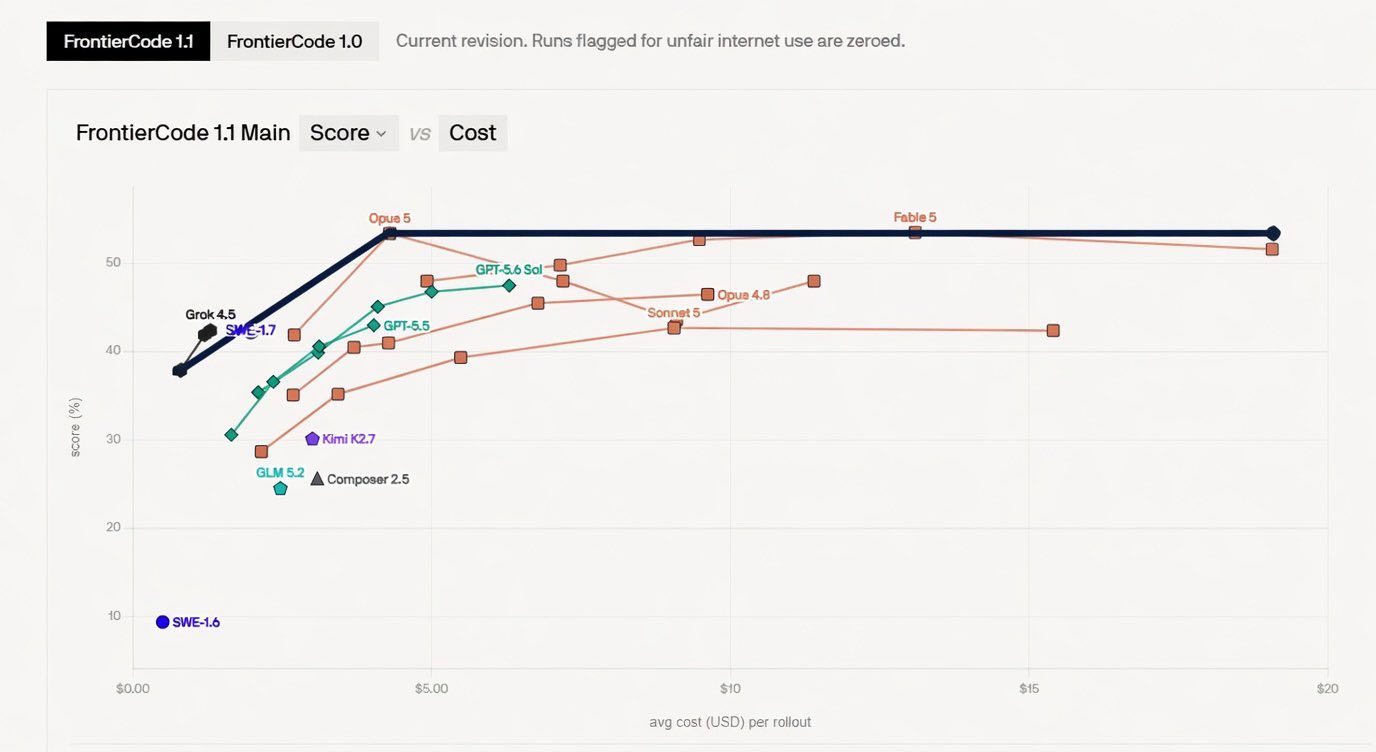
If you’ve been following the latest developments in artificial intelligence, you’ve probably come across the claim that “Grok 4.5 and Opus 5 are alone on the Pareto frontier.” It’s a bold statement—but what does it actually mean?
Let’s break it down.
What Is the Pareto Frontier?
The Pareto frontier (also known as the Pareto optimal frontier) is a concept from economics and optimization. It describes a set of solutions where improving one characteristic inevitably requires sacrificing another.
Applied to large language models (LLMs), the Pareto frontier represents models that offer the best trade-offs across different performance dimensions. If a model sits on the frontier, there is no other model that is better in every meaningful aspect.
In simple terms, these are the models that deliver the most value without being clearly outperformed by competitors.
Which Trade-Offs Matter?
There isn’t just one way to evaluate an AI model. Different users prioritize different capabilities, including:
- Reasoning ability
- Coding performance
- Creative writing
- Mathematical accuracy
- Context window size
- Response speed (latency)
- Operating cost
- Reliability and consistency
- Tool use and agent capabilities
A model may excel in one area while making compromises in another. That’s exactly why the Pareto frontier exists.
Are Grok 4.5 and Opus 5 the Only Models on It?
The short answer is: it depends.
The statement assumes a specific set of evaluation criteria. If those criteria heavily emphasize advanced reasoning, coding performance, and writing quality—while placing less importance on cost or latency—it’s possible that Grok 4.5 and Opus 5 emerge as leading contenders.
However, changing the evaluation dimensions can completely reshape the frontier.
For example:
- A faster model may offer a better balance for real-time applications.
- A lower-cost model may provide significantly better value for production deployments.
- Another model may outperform both in multimodal tasks or tool integration.
In other words, there is no universal Pareto frontier for AI models. The frontier changes depending on which metrics are being optimized.
Why the AI Frontier Keeps Changing
Unlike traditional software, AI models evolve rapidly.
New releases from companies such as OpenAI, Anthropic, Google, xAI, and the open-source community continually shift the competitive landscape. Improvements in architecture, training methods, inference efficiency, and pricing can quickly move a model onto—or off—the Pareto frontier.
A model considered state-of-the-art today may be surpassed just a few months later.
The Bigger Picture
Rather than asking which model is “the best,” a more useful question is:
Which model offers the best trade-off for my specific use case?
A software engineer may prioritize coding accuracy.
A content creator may value creativity and long-form writing.
An enterprise may focus on reliability, security, and cost efficiency.
Each scenario can produce a different answer—and potentially a different Pareto frontier.
Final Thoughts
The claim that “Grok 4.5 and Opus 5 are alone on the Pareto frontier” should be viewed as an opinion based on a particular set of benchmarks and priorities, not as an objective fact.
There is no single, universally accepted Pareto frontier for large language models. The answer depends on the evaluation criteria, the trade-offs being considered, and the rapidly evolving state of AI technology.
As new models continue to emerge, today’s frontier may look very different tomorrow. That’s why it’s important to evaluate AI models in the context of your own goals rather than relying solely on broad claims or leaderboard rankings.
Want more articles and tutorials like this?
Get new tutorials, security alerts, and IT tips straight to your inbox.