What Is a Honeypot in Cybersecurity? A Beginner’s Guide

If you’re new to cybersecurity, you’ve probably come across the word “honeypot” and wondered what it actually means. It sounds sweet, but it’s actually one of the cleverest tricks security teams use to catch hackers in the act. In this guide, we break down what a honeypot is, how it works, the different types you’ll encounter, and why beginners in IT and cybersecurity should understand this concept early on.
Table of Contents
- What Is a Honeypot?
- How Does a Honeypot Work?
- Why Do Companies Use Honeypots?
- Types of Honeypots by Purpose
- Types of Honeypots by Interaction Level
- Real-World Examples of Honeypots
- Benefits of Using Honeypots
- Risks and Limitations of Honeypots
- Honeypots vs Honeynets: What’s the Difference?
- Who Should Learn About Honeypots?
- Conclusion
- Frequently Asked Questions (FAQ)
What Is a Honeypot?
A honeypot is a decoy system that pretends to be a real target. It could look like a company database, a login page, a file server, or even an entire fake network. The trick is simple: the honeypot has no real business value, so nobody with a legitimate reason should ever touch it.
That means any activity inside a honeypot is almost always a hacker, a bot, or a curious intruder poking around where they shouldn’t be. Security teams use this fact to their advantage, turning the honeypot into an early warning system.
Think of it like a fake package left on a porch with a hidden camera. Nobody is supposed to open it. If someone does, you know exactly who to watch.
How Does a Honeypot Work?
A honeypot works by looking exactly like a normal system a hacker would want to break into. It runs services, holds fake files, and sometimes even simulates user activity. Behind the scenes, every action inside the honeypot gets logged in detail.
When an attacker interacts with the honeypot, the security team collects data such as:
- The attacker’s IP address and general location
- The tools and techniques used to break in
- Commands typed once inside the system
- Malware samples dropped during the attack
- How long the attacker stayed and what they searched for
None of this activity touches real company systems, which keeps actual data safe while still gathering useful intelligence.
Why Do Companies Use Honeypots?
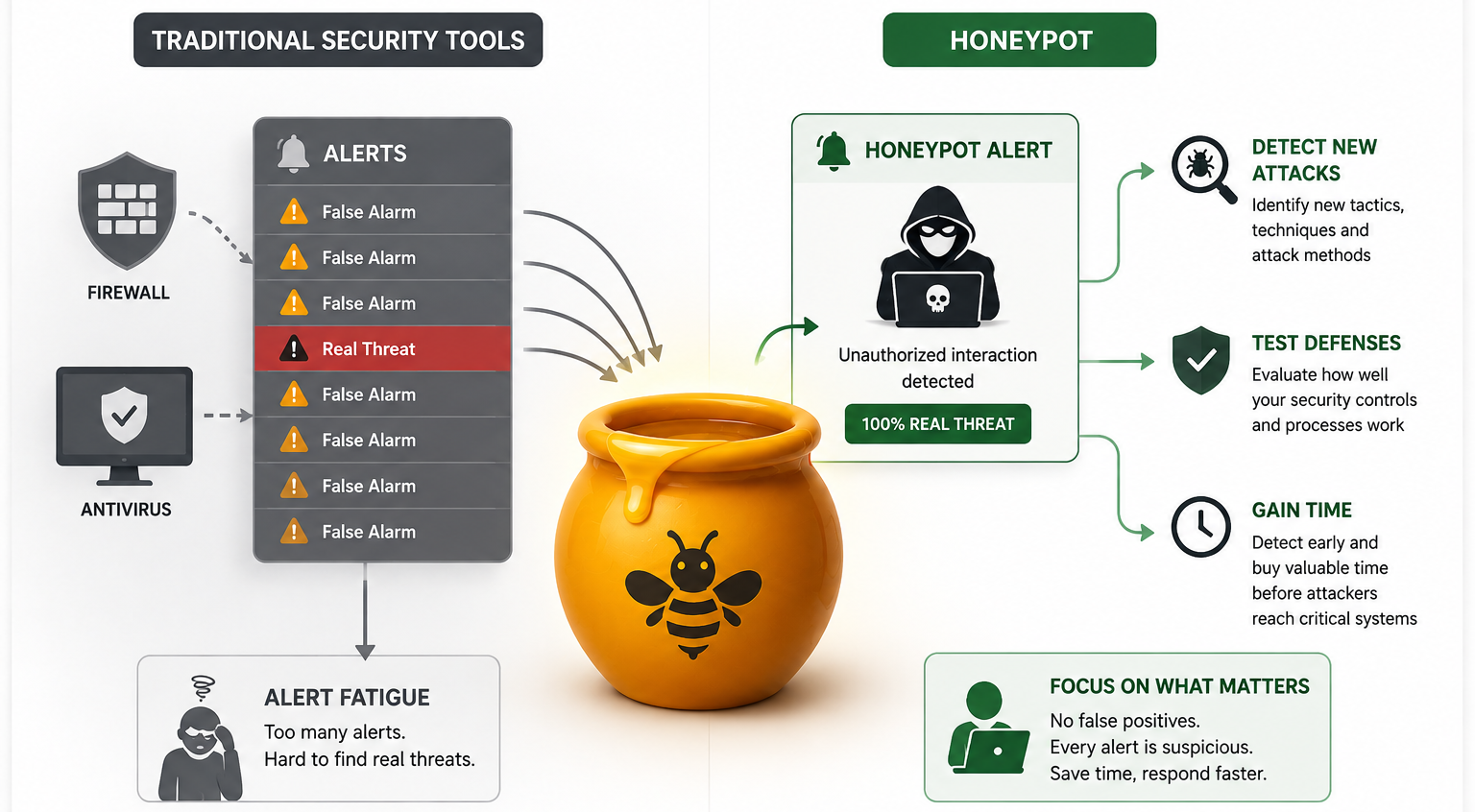
Traditional security tools like firewalls and antivirus software generate huge numbers of alerts every day. Many of these turn out to be false alarms, which creates alert fatigue for IT teams trying to separate real threats from noise.
Honeypots solve this problem in a clever way. Since a honeypot has no legitimate purpose, any interaction with it is automatically suspicious. There’s no such thing as a false positive on a honeypot, because a normal employee or customer would never have a reason to access it.
This makes honeypots incredibly efficient for spotting new attack methods, testing how well existing defenses hold up, and buying extra time before an attacker reaches valuable systems.
Types of Honeypots by Purpose
Security professionals usually group honeypots into two broad purposes: research and production.
Research Honeypots
Research honeypots exist to study attacker behavior on a large scale. Universities, government agencies, and cybersecurity vendors often run these to track global hacking trends, new malware families, and emerging attack patterns.
These honeypots aren’t tied to a specific company’s network. Instead, they sit out in the open internet, collecting data from anyone who stumbles across them. The findings often turn into published research or updated protection tools used across the industry.
Production Honeypots
Production honeypots sit inside a real company’s network, right alongside actual servers and databases. Their job is more focused: catch intruders early and protect the business.
Because they mimic a specific organization’s systems, production honeypots give IT teams a realistic picture of how attackers might try to break into their particular environment, not just the internet in general.
Types of Honeypots by Interaction Level
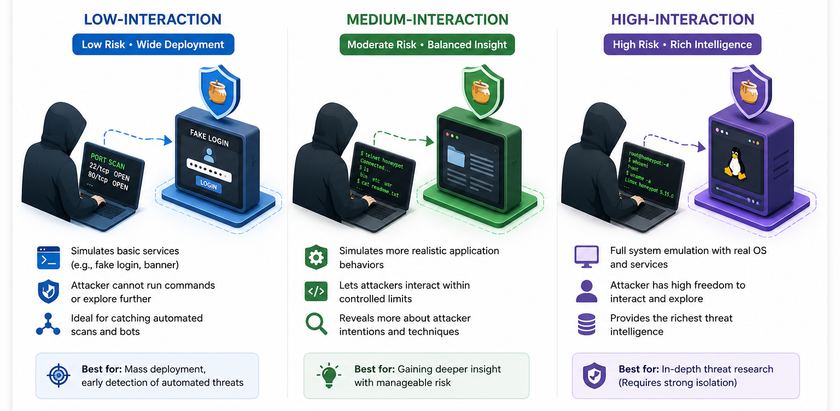
Beyond purpose, honeypots also differ in how much freedom they give an attacker once inside. This is called the interaction level.
Low-Interaction Honeypots
Low-interaction honeypots simulate only basic services, like a fake login screen that goes nowhere. The attacker can’t actually run commands or explore further.
Because they’re simple and low risk, teams often deploy many low-interaction honeypots across a network to catch mass, automated attacks such as bots scanning for open ports.
Medium-Interaction Honeypots
Medium-interaction honeypots offer a bit more realism. They simulate certain application behaviors, giving the attacker enough rope to reveal more about their intentions, without granting full system access.
High-Interaction Honeypots
High-interaction honeypots are the most convincing, and the riskiest. These behave like fully functioning systems, complete with real operating system responses and services the attacker can interact with.
Because the attacker has more freedom, security teams gather much richer intelligence. However, this type needs careful isolation, since a poorly contained high-interaction honeypot could theoretically be used to attack other systems.
Real-World Examples of Honeypots
To make this more concrete, imagine a power company that sets up a fake database labeled with plant locations and energy grid details. It looks valuable, but it’s entirely fake. Any attacker who breaks in and starts poking around reveals their methods immediately, all without putting the real grid at risk.
Another common example is a fake customer billing system. Since billing systems are popular targets for stolen credit card data, a decoy version can lure in criminals hunting for that exact kind of information, while the real billing platform stays untouched.
Benefits of Using Honeypots
Honeypots offer several advantages that make them a valuable addition to a broader security strategy.
- Early breach detection. Honeypots often catch intruders before they reach real systems.
- Fewer false alarms. Any activity is a genuine red flag, cutting through alert fatigue.
- Real attacker insight. Teams learn actual tools, tactics, and motives instead of guessing.
- Time buyer. Attackers waste time and effort on a fake target instead of a real one.
- Better defense tuning. Lessons from honeypots help teams strengthen firewalls, detection rules, and response plans.
Risks and Limitations of Honeypots
Honeypots aren’t a perfect solution, and beginners should understand their limits too.
If a honeypot isn’t properly isolated, a skilled attacker could potentially use it as a stepping stone to reach other parts of the network. This is why isolation and monitoring matter so much when setting one up.
Honeypots also only catch attackers who actually interact with them. A cautious or highly targeted attacker might avoid the decoy entirely and go straight for the real system, meaning honeypots work best as one layer of defense, not the only one.
Finally, running and monitoring honeypots takes ongoing effort. Someone needs to review the logs, update the fake environment, and make sure it still looks convincing over time.
Honeypots vs Honeynets: What’s the Difference?
A honeynet is simply a network of honeypots working together. Instead of one fake server, a honeynet might include multiple systems, databases, and routers, all designed to look like a complete company network.
Because a honeynet feels more realistic and complex, attackers often spend more time exploring it. This gives security teams a deeper, longer look into how the attacker thinks and operates, compared to a single standalone honeypot.
Who Should Learn About Honeypots?
Honeypots are a great starting point for anyone curious about cybersecurity, ethical hacking, or IT defense strategy. Beginners studying for certifications, students exploring security as a career, and small business owners wanting to understand modern threats can all benefit from grasping this concept.
You don’t need advanced technical skills to understand the idea. What matters most at the beginner stage is understanding the purpose: honeypots turn the tables on attackers by making them the ones being watched.
Conclusion
A honeypot is one of the more creative tools in the cybersecurity world. Instead of only building walls to keep attackers out, honeypots invite them in on purpose, into a controlled, fake environment where every move gets recorded. This approach helps organizations catch threats early, reduce false alarms, and learn directly from real attacker behavior.
Whether it’s a simple low-interaction decoy or a full honeynet mimicking an entire company, the core idea stays the same: make the trap look valuable, watch closely, and turn attacker curiosity into useful defense knowledge. For anyone starting out in cybersecurity, honeypots are a simple but powerful concept worth understanding early.
Frequently Asked Questions (FAQ)
Is a honeypot illegal to use? No. Companies and researchers use honeypots legally as a defensive security tool. The legality depends on how it’s deployed, not the concept itself.
Can a honeypot get hacked? Yes, that’s actually the point. A honeypot is meant to be broken into. The key is making sure the attacker can’t escape it and reach real systems.
Do small businesses need honeypots? Not always. Honeypots are more common in medium to large organizations with dedicated security teams, though simple versions can benefit smaller businesses too.
Are honeypots the same as antivirus software? No. Antivirus software blocks known threats, while honeypots lure and study attackers to gather new intelligence about unknown threats.
How long does an attacker usually stay in a honeypot? It varies widely. Low-interaction honeypots might only get a few seconds of bot activity, while high-interaction honeypots or honeynets can hold a curious attacker’s attention for hours or even days.
Want more articles and tutorials like this?
Get new tutorials, security alerts, and IT tips straight to your inbox.