Zero-Day CrowdStrike Falcon: Privilege Escalation Vulnerability

A new proof-of-concept called FalconFlank is making the rounds in security circles this week. It claims to let a low-privileged Windows user jump to full SYSTEM access by abusing a feature inside CrowdStrike’s Falcon Sensor. CrowdStrike has not confirmed the flaw, and no CVE exists yet. Still, if you run Falcon across your Windows fleet, you need to understand what’s being claimed, what’s verified, and what to do while the situation develops. Here’s a plain-language breakdown.
Table of Contents
- What Is FalconFlank?
- How the Vulnerability Reportedly Works
- Confirmed vs. Unconfirmed: What We Actually Know
- Who Is at Risk
- CrowdStrike’s Response So Far
- What Security Teams Should Do Right Now
- Why This Post Won’t Include the Exploit Code
- How This Fits CrowdStrike’s Track Record
- Detection and Monitoring Strategies
- Mitigation and Hardening Steps
- FAQ
- Conclusion
What Is FalconFlank?
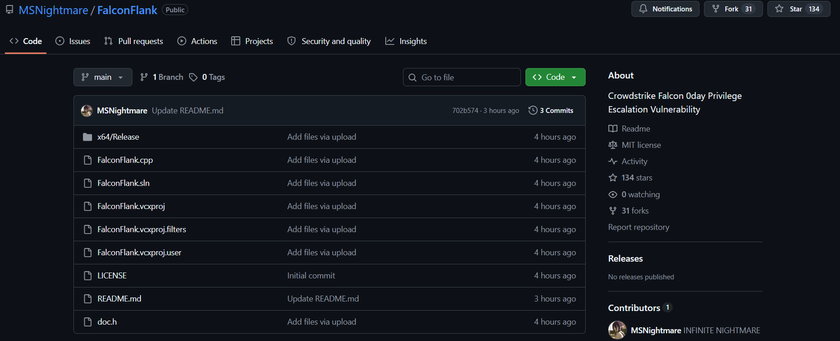
FalconFlank is a public GitHub project from a researcher who goes by Nightmare-Eclipse, also known online as Chaotic Eclipse or MSNightmare. The repository describes itself as a zero-day privilege escalation vulnerability in CrowdStrike’s Falcon Sensor, the endpoint detection and response (EDR) agent that many organizations run on Windows machines to catch malware and intrusions.
The project ships C source code, a Visual Studio solution, and a pre-built x64 release. According to the README, the technique targets a specific Falcon capability: automatic removal of malicious macros found inside Microsoft Office files. The researcher claims it worked on a fully patched Windows 11 25H2 machine and on Windows Server 2025, with Falcon running its highest protection tier.
How the Vulnerability Reportedly Works
The Macro Remediation Feature
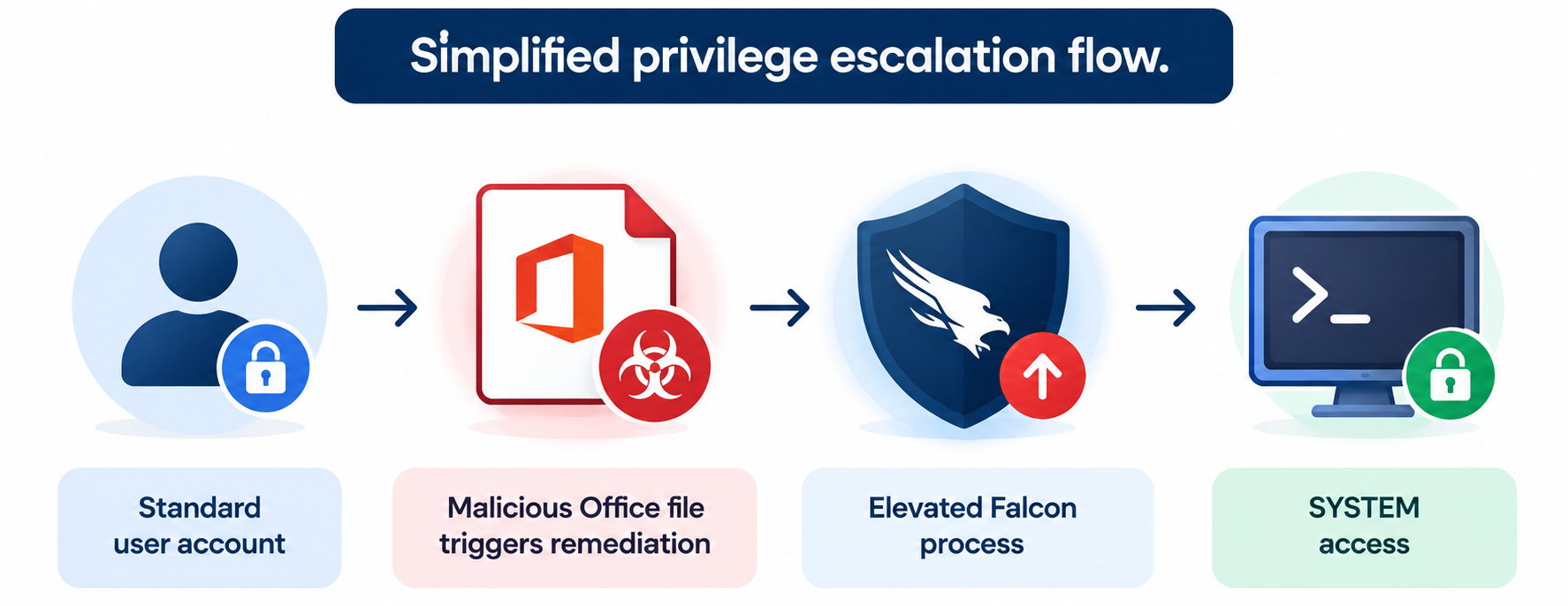
Falcon includes a setting that automatically strips or quarantines malicious macros it finds inside Office documents like Word or Excel files. This remediation process needs elevated permissions, because it has to reach into protected file locations to delete or modify content that a regular user account normally can’t touch.
That elevated access is exactly what security researchers look for. Any process that runs with more privilege than the user who triggered it becomes a potential target. If an attacker can trick that process into touching a file it shouldn’t, loading a library it shouldn’t load, or following a path it shouldn’t follow, the attacker can sometimes ride along and inherit those higher privileges.
The Privilege Escalation Path
FalconFlank reportedly does exactly that. The PoC allegedly manipulates how Falcon’s remediation workflow handles a flagged Office file, tricking the elevated process into a state that hands the attacker SYSTEM-level access — the highest privilege level on a Windows machine. SYSTEM access would let an attacker install software, dump credentials, disable security tools, or move deeper into a network, all from a starting point of an ordinary user account.
Local privilege escalation bugs like this one don’t get an attacker into a machine on their own. They need an existing foothold first, such as a phished user account or a compromised low-privilege session. Once that foothold exists, though, a working LPE turns a minor breach into a major one.
Confirmed vs. Unconfirmed: What We Actually Know
It’s worth separating fact from claim here, because headlines move faster than verification.
Confirmed:
- The FalconFlank repository is public and contains working code, not just a description.
- Multiple security outlets have covered the release and reviewed the README’s claims.
- CrowdStrike had not published an advisory, CVE, or patch note for this specific issue at the time of writing.
Unconfirmed:
- Whether the PoC reliably works the way the researcher describes.
- Whether it still works after CrowdStrike’s likely detection updates.
- The real-world exploitability across different Falcon configurations and versions.
Independent researchers and outlets covering the story have been careful to label this an unverified claim, not a confirmed vulnerability. That distinction matters for how you respond. You should take it seriously, but you shouldn’t panic or assume every Falcon deployment is instantly compromised.
Who Is at Risk
Based on what the researcher published, three conditions need to line up for this issue to matter to you:
- You run CrowdStrike Falcon Sensor on Windows endpoints or servers.
- The “Microsoft Office file malicious macro removal” capability is turned on in your Falcon configuration.
- An attacker already has some form of local access to a machine, such as through phishing, a compromised account, or physical access.
Falcon deployments on Mac and Linux are not part of this claim. Organizations that don’t enable the macro remediation feature are also less likely to be affected, though configurations can change over time and across device groups, so it’s worth checking rather than assuming.
Think about who typically has local access in your environment. Shared workstations, kiosk-style machines, contractor laptops, and any device where multiple people log in under separate low-privilege accounts all raise your exposure. So does any recent phishing activity that may have already handed an attacker a low-privilege foothold, even one your team hasn’t fully investigated yet. If you’ve had a recent phishing incident, this is a good moment to revisit it with local privilege escalation specifically in mind.
Organizations in regulated industries, such as healthcare, finance, and government contracting, carry extra weight here too. A confirmed SYSTEM-level compromise on a regulated endpoint can trigger breach notification obligations even if no data actually left the network, simply because the access level crossed a compliance threshold. It’s worth looping in your compliance or legal team early if you suspect any exposure, rather than waiting for full confirmation.
CrowdStrike’s Response So Far
As of publication, CrowdStrike has not issued a public advisory, CVE identifier, or patch note tied to FalconFlank. The researcher’s own README suggests that CrowdStrike’s detection engine may already flag the published PoC, meaning testing it in a lab could trigger existing alerts rather than slip past them.
Security teams should treat this as a developing story. Watch CrowdStrike’s official security advisories page, the Falcon console’s notification center, and your account team’s communications for updates. Vendors typically move quickly once a public PoC forces their hand, so expect guidance or a patch within days rather than weeks if the claim holds up.
What Security Teams Should Do Right Now
Immediate Steps
- Check your Falcon configuration. Find out whether the Office malicious-macro removal capability is enabled across your device groups, and review why.
- Increase log review. Pull Falcon detection logs, prevention events, and Windows audit logs, and look for unusual Office-related remediation activity or unexpected DLL loads.
- Avoid running the public PoC on production systems. If your team wants to validate the claim, do it in an isolated lab, never on a live endpoint.
- Report findings responsibly. If you reproduce the issue, submit it through CrowdStrike’s official vulnerability disclosure process rather than posting more detail publicly.
Longer-Term Hardening
- Apply least privilege. Limit which accounts run with local admin rights, since that reduces how much damage a successful escalation can cause.
- Segment sensitive systems. Keep high-value servers on tighter network segments so a single compromised endpoint doesn’t open the whole environment.
- Patch promptly once CrowdStrike responds. Build a fast-track process for security-agent patches specifically, since these tools sit deep in your systems and a delay here carries outsized risk.
- Test incident response playbooks. Use this as a trigger to walk through your team’s plan for a local privilege escalation scenario, so muscle memory is ready if a real incident hits.
- Review your Office macro policy separately. Macro-based attacks are exactly what the Falcon feature in question tries to catch, so make sure your broader Office macro controls, such as blocking macros from the internet by default, still stand on their own even if you temporarily adjust the Falcon setting.
- Talk to your CrowdStrike account team directly. Vendors often share more detail with paying customers under a support ticket than they publish openly, especially while an issue is still under investigation.
A useful way to frame this internally is to treat it like any other unpatched local privilege escalation report, not as a CrowdStrike-specific emergency. The same discipline that protects you from an unpatched Windows kernel bug or a browser sandbox escape applies here: reduce the number of accounts that could act as a stepping stone, watch for unusual process behavior, and close the patching gap as soon as one exists.
Why This Post Won’t Include the Exploit Code
You’ll notice we’ve described how the technique reportedly works without publishing the actual code, commands, or step-by-step reproduction instructions. That’s a deliberate choice, not an oversight. Exploit code for an unpatched, unconfirmed local privilege escalation mostly helps attackers move faster; defenders don’t need working exploit code to protect themselves, they need to know what to monitor and patch. If you’re a security researcher who needs the technical detail for legitimate testing, the original GitHub repository and the vendor’s own disclosure channel are the right places to go, not a general audience blog post.
How This Fits CrowdStrike’s Track Record
This isn’t the first time CrowdStrike has faced public scrutiny over Falcon’s engineering. In October 2025, the company patched a race-condition flaw and a logic error in Windows sensor versions, both found through its own bug bounty program, with no evidence of active exploitation at the time. And in July 2024, a faulty Falcon content update caused a massive global outage that grounded flights and disrupted hospitals and banks, an incident that drew months of scrutiny from Congress and the security industry over CrowdStrike’s testing and rollout practices.
None of that means FalconFlank is confirmed real. It does mean CrowdStrike operates one of the most widely deployed EDR agents on the planet, so any credible claim against it deserves attention, and any confirmed one deserves a fast, careful response from customers.
Detection and Monitoring Strategies
Telemetry Integrity Monitoring
The most effective defense against FalconFlank-style attacks starts with telemetry integrity. Security teams should treat gaps in EDR data as alerts, not inconveniences. Build monitoring that knows what “healthy” looks like for every sensor:
- EDR agents must report on schedule
- ETW sessions must produce normal event volumes
- Security services must remain running
- Key providers must stay active
When any of these signals drop, trigger an alert. In an evasion-first threat landscape, silence often signals compromise.
Behavioral Sequence Analytics
Static rules that match known-bad indicators catch only yesterday’s attacks. Modern defenders need behavioral analytics that reason over sequences. Monitor process lineage, parent-child relationships, and the chain connecting a document open to a scripting engine to a network connection.
For FalconFlank specifically, watch for:
- Office applications spawning unexpected child processes during macro scans
- Falcon-related processes loading unsigned or unexpected DLLs
- Privilege escalation events tied to remediation threads
- Suspicious registry modifications following macro cleanup
Baseline Normal LOLBin Usage
Living-off-the-land binaries (LOLBin) like powershell.exe, wscript.exe, and mshta.exe appear in nearly every enterprise. You cannot block them. Instead, baseline their normal usage. Learn which hosts run them, which parent processes invoke them, and at what times. Then alert on deviations. If a Falcon remediation thread suddenly launches PowerShell, that is abnormal. Treat it as suspicious.
Mitigation and Hardening Steps
Immediate Actions
- Update the Falcon sensor. CrowdStrike typically patches disclosed vulnerabilities quickly. Ensure every endpoint runs the latest version.
- Audit exclusions. Review all prevention policy exclusions. Attackers often abuse overly broad exclusions to bypass detection. Remove any exclusion that is not strictly necessary.
- Enable tamper protection. CrowdStrike Falcon includes tamper protection features that prevent unauthorized modification of the sensor. Turn these on across the fleet.
- Restrict macro remediation policies. If your organization does not need automatic Office macro removal, disable it. If you do need it, scope the policy tightly to specific document types and user groups.
Medium-Term Hardening
- Deploy Hypervisor-Protected Code Integrity (HVCI). HVCI prevents vulnerable or malicious drivers from loading. Run the Microsoft Defender HVCI Readiness tool and enable HVCI on capable endpoints.
- Enable Attack Surface Reduction (ASR) rules. Switch your top three ASR rules from audit mode to enforce mode. Rules that block Office applications from creating child processes directly counter macro-based attack chains.
- Implement application control. Use Windows Defender Application Control (WDAC) or AppLocker to restrict which DLLs can load into trusted processes. This adds friction to injection-based attacks.
Long-Term Strategy
- Adopt an assume-breach posture. With average eCrime breakout times dropping to 29 minutes, defenders cannot rely on front-door detection alone. Design your architecture to detect and contain fast. Test incident-response playbooks regularly. Maintain the ability to isolate hosts and revoke sessions within minutes.
- Validate with purple teaming. Detection you have never tested is a belief, not a control. Run adversary simulations that emulate FalconFlank-style techniques. Pair red-team operators with blue-team defenders in real time. Map every gap to a new or tuned detection before the exercise ends.
FAQ
Is FalconFlank a confirmed CrowdStrike vulnerability? No. It’s a public proof-of-concept with an unverified claim. CrowdStrike hadn’t issued an advisory or CVE at the time of writing.
Does this affect Mac or Linux systems running Falcon? The claim is specific to Windows systems, including Windows 11 25H2 and Windows Server 2025 in the researcher’s tests.
What Falcon setting does the exploit reportedly need? The “Microsoft Office file malicious macro removal” capability. Disabling it, after weighing the trade-offs for your environment, may reduce exposure while the claim is investigated.
Can this be exploited remotely? No. It’s described as a local privilege escalation, meaning an attacker needs existing access to the machine before this technique becomes useful.
Should I panic and disable Falcon? No. Disabling your EDR agent removes far more protection than it saves you, especially against an unconfirmed local escalation. Focus on monitoring, configuration review, and staying current with CrowdStrike’s guidance instead.
Where should I get updates on this story? CrowdStrike’s official security advisories page and your Falcon console notifications are the most reliable sources. Treat third-party coverage, including this post, as a starting point rather than the final word.
Conclusion
FalconFlank is a serious enough claim to act on, even though it isn’t confirmed yet. A researcher published working code alleging that CrowdStrike Falcon’s own macro-remediation feature can be turned against itself to grant SYSTEM access on a fully patched Windows machine. CrowdStrike hasn’t validated the bug, so the responsible move is measured vigilance: check your configuration, tighten log monitoring, avoid testing on production systems, and watch official channels for a fix. Security tools are high-value targets precisely because they run with elevated trust, and stories like this one are a useful reminder to keep least-privilege principles, patch discipline, and incident-response readiness in place regardless of which vendor’s name is in the headline.
Want more articles and tutorials like this?
Get new tutorials, security alerts, and IT tips straight to your inbox.