Defense in Depth: The 7 Layers of Cybersecurity and Their Role in ISO 27001
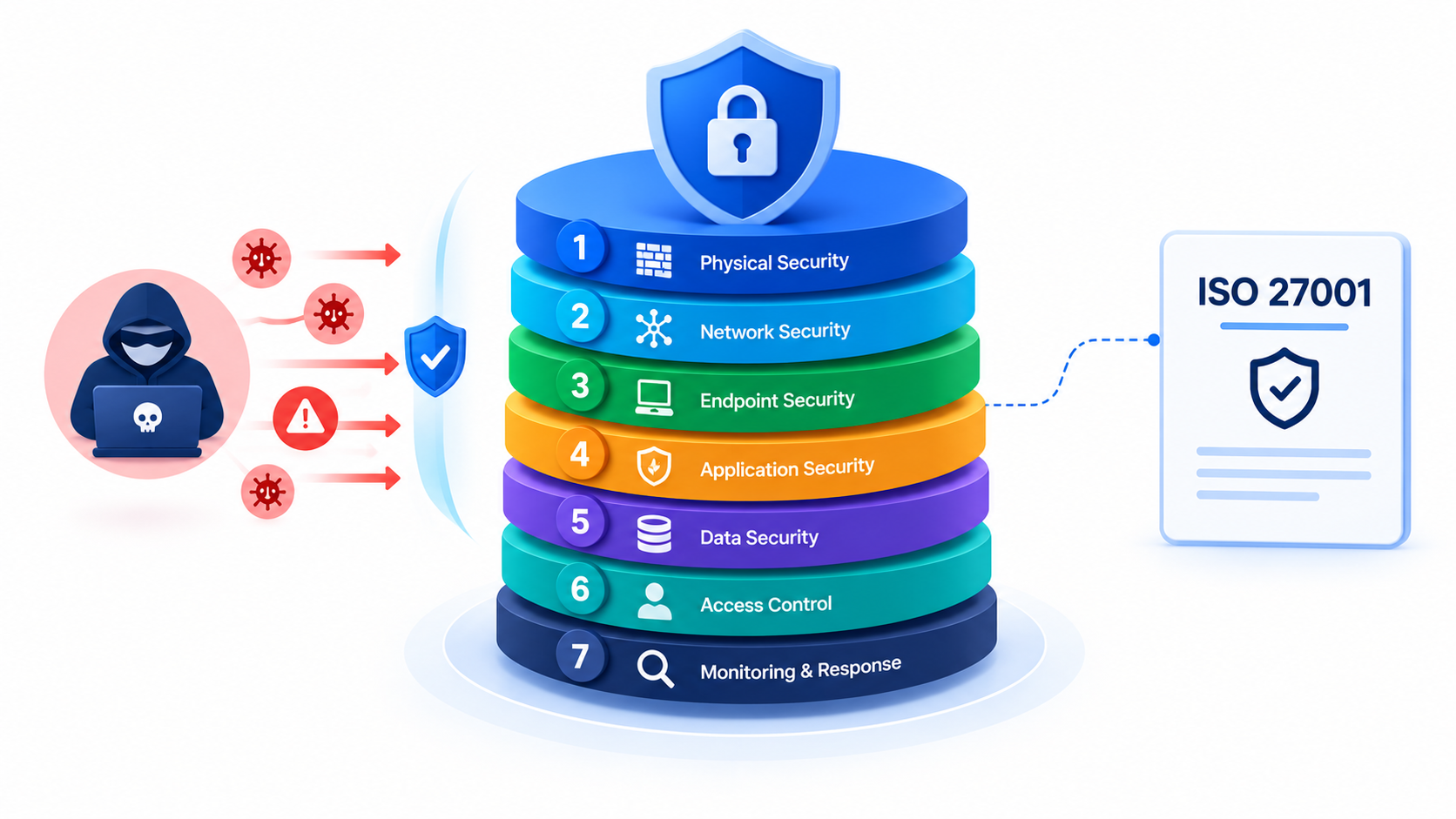
Cyberattacks rarely exploit just one weakness. An attacker might enter through a phishing email, exploit an unpatched server, move across the network, and steal sensitive information. If an organization relies on a single security solution, one successful attack can compromise the entire system. This is why cybersecurity professionals use defense in depth, an approach that combines multiple security layers to reduce risks, detect attacks, and limit their impact.
In this article, we explore the seven layers of cybersecurity, explain how they work together, and examine how ISO/IEC 27001:2022 helps organizations build a structured, risk-based security program.
Table of Contents
- What Is Defense in Depth in Cybersecurity?
- Why Is a Single Security Solution Not Enough?
- The 7 Layers of Cybersecurity
- How the Seven Layers Work Together
- Defense in Depth and ISO/IEC 27001:2022
- How to Implement Defense in Depth in an Organization
- Common Mistakes to Avoid
- Defense in Depth vs. Zero Trust
- Conclusion
- Frequently Asked Questions
What Is Defense in Depth in Cybersecurity?
Defense in depth is a cybersecurity strategy that uses multiple, complementary security controls to protect an organization’s systems, networks, applications, and data.
Instead of depending on one security product, an organization deploys several protective measures across its IT infrastructure. Each layer addresses different risks and provides additional protection when another control fails.
For example, a company might use:
- Physical access controls to protect its server room.
- Firewalls to filter network traffic.
- Network segmentation to isolate critical systems.
- Endpoint detection and response (EDR) to identify suspicious activity.
- Secure development practices to reduce application vulnerabilities.
- Encryption and access controls to protect sensitive data.
- Security awareness training to reduce phishing risks.
These controls work together to make unauthorized access more difficult and help security teams detect and contain incidents.
What Are the Main Objectives of Defense in Depth?
A defense-in-depth strategy typically serves four main purposes.
1. Prevent attacks: Security controls block unauthorized access and reduce the number of exploitable weaknesses.
2. Detect suspicious activity: Monitoring systems identify unusual behavior that preventive controls might miss.
3. Contain security incidents: Network segmentation, restricted privileges, and endpoint isolation help prevent an attack from spreading.
4. Support recovery: Reliable backups, incident response procedures, and disaster recovery plans help organizations restore operations after an incident.
The objective is not to eliminate every possible threat. No security architecture can guarantee that result. Instead, defense in depth reduces the likelihood and impact of successful attacks.
Why Is a Single Security Solution Not Enough?
Many organizations begin their cybersecurity strategy by installing an antivirus solution and configuring a firewall. These technologies are important, but they cannot address every attack scenario.
A firewall may block unauthorized connections from the internet, but it cannot reliably prevent an employee from entering credentials into a fraudulent website.
An antivirus solution may detect known malware, but an attacker could exploit a vulnerable web application or use legitimate administrative tools to move through a compromised environment.
Similarly, encryption can protect stolen data from unauthorized reading, but it does not automatically prevent an attacker from accessing that data through a compromised account with legitimate permissions.
Consider the following example.
A company employee receives a phishing email containing a link to a fraudulent login page. The employee enters their corporate credentials, allowing the attacker to access the company’s cloud environment.
If the company relies only on a firewall and antivirus software, the attacker may still gain access through legitimate authentication mechanisms.
A layered security architecture can reduce the impact:
- Email security identifies or blocks the suspicious message.
- Security awareness training helps the employee recognize the phishing attempt.
- Multi-factor authentication (MFA) adds a second authentication requirement.
- Identity monitoring detects unusual sign-in behavior.
- Access controls restrict the resources available to the compromised account.
- Endpoint and cloud monitoring identify suspicious activity.
- Incident response procedures help the security team contain the incident.
Each control addresses a different part of the attack. Even if one fails, other controls may prevent the attacker from reaching critical information.
This is the fundamental principle behind defense in depth: do not let the failure of one security control become the failure of the entire organization.
The 7 Layers of Cybersecurity
The seven-layer model below provides a practical way to understand defense in depth.
These layers are a pedagogical model, not an official seven-layer structure mandated by ISO/IEC 27001. Organizations may use different security architectures depending on their technologies, business requirements, and risk assessments.
1. Physical Security
Physical security protects the buildings, rooms, equipment, and infrastructure that support an organization’s IT systems.
Cybersecurity is not limited to digital threats. An attacker who gains physical access to a server, workstation, network switch, or backup device may bypass many of the organization’s logical security controls.
For example, an unauthorized person who enters an unlocked server room could disconnect equipment, steal storage devices, or connect a malicious device to the internal network.
Common Physical Security Controls
Organizations can implement several measures to reduce these risks:
- Badge-based access control for restricted areas.
- Biometric authentication where appropriate.
- Security cameras and intrusion detection systems.
- Visitor registration and escort procedures.
- Locked server racks and equipment cabinets.
- Environmental monitoring for temperature, humidity, and water leaks.
- Secure storage and disposal of hardware.
- Physical protection for backup media and network infrastructure.
Access should follow the principle of least privilege. Employees and contractors should enter restricted areas only when their responsibilities require it.
Organizations should also review physical access permissions regularly and revoke them when employees leave or change roles.
Practical Example
A company hosts its critical databases in a restricted server room.
Only authorized IT personnel can enter using an access badge. Security cameras monitor the entrance, and the organization records access events.
If someone attempts to enter without authorization, the organization can investigate the event and determine whether additional controls are necessary.
Key takeaway: Physical security protects the infrastructure that makes every other cybersecurity layer possible.
2. Perimeter Security
Perimeter security controls traffic entering and leaving an organization’s network or exposed services.
Its purpose is to reduce unauthorized access, block known threats, and limit the organization’s exposure to the internet.
Although traditional perimeter security focuses on the boundary between internal and external networks, modern environments also require protection for cloud services, remote users, and distributed applications.
Common Perimeter Security Controls
Firewalls: Filter network connections according to configured security rules.
Web application firewalls (WAFs): Inspect HTTP and HTTPS requests to help protect web applications against attacks such as SQL injection and cross-site scripting.
Email security gateways: Detect malicious attachments, phishing messages, suspicious links, and email spoofing.
VPN gateways: Provide encrypted connections for authorized remote users when a VPN is appropriate for the environment.
DNS filtering: Blocks requests to known malicious domains.
Intrusion prevention systems (IPS): Inspect traffic and block activity that matches configured detection rules.
Secure remote access: Restricts access to exposed administrative services and requires appropriate authentication.
Practical Example: Restricting SSH Access
Suppose a Linux server provides an SSH service on TCP port 22.
If administrators can connect only from a trusted management network, the firewall should enforce that restriction.
For example, on a Linux system using UFW, an administrator could configure the following rule:
sudo ufw allow from 192.168.10.0/24 to any port 22 proto tcpThis rule allows SSH connections from the specified subnet.
Before applying it, administrators should verify that the subnet matches their actual management network and that the firewall’s existing rules are appropriate.
Important: This command does not automatically block every other source from accessing SSH. The administrator must also review the complete firewall policy and ensure that no conflicting rule permits unrestricted access.
Perimeter security should reduce unnecessary exposure, not simply allow or block traffic without considering business requirements.
Why Perimeter Security Matters
Internet-facing systems are common targets for automated scanning, credential attacks, and exploitation of exposed services.
Restricting unnecessary services and filtering traffic can reduce the attack surface. However, perimeter controls cannot replace endpoint protection, identity security, or application security.
Key takeaway: Perimeter security limits exposure to external threats, but organizations must also protect systems after an attacker crosses the boundary.
3. Network Security
Network security protects communications between systems, devices, servers, and applications.
While perimeter security focuses on traffic entering and leaving an environment, network security also addresses internal communications.
This distinction matters because attackers often attempt to move laterally after compromising an initial system.
For example, an attacker who compromises an employee workstation may try to access file servers, administrative systems, databases, or other endpoints on the same network.
Without effective segmentation and monitoring, one compromised device could provide access to much more sensitive resources.
Common Network Security Controls
Organizations can strengthen network security through:
- Network segmentation using VLANs, subnets, and routing policies.
- Internal firewalls between sensitive network zones.
- Network access control (NAC).
- Intrusion detection and prevention systems.
- Encrypted communications using appropriate protocols.
- Secure DNS and network infrastructure configuration.
- Network traffic monitoring and logging.
- Restrictions on administrative protocols.
- Separate management networks for critical infrastructure.
Network Segmentation Explained
Network segmentation divides a network into smaller security zones.
For example, a company might separate its environment into these segments:
| Network segment | Purpose | Example controls |
|---|---|---|
| User network | Employee workstations | Endpoint protection and restricted server access |
| Server network | Business applications | Internal firewall rules and access restrictions |
| Database network | Sensitive data storage | Strict application-specific access |
| Management network | Administrative interfaces | Restricted administrator access and MFA |
| Guest network | Visitors and personal devices | Internet access without internal network access |
Each segment should permit only the communications required for legitimate business operations.
If an employee workstation becomes compromised, segmentation can make it more difficult for the attacker to reach a database or management interface.
However, segmentation works only when administrators configure and maintain effective access rules.
Practical Example
Consider a web application with three components:
- A public-facing web server.
- An application server.
- A database server.
The network policy could permit:
- Internet users to connect to the web server over HTTPS.
- The web server to communicate with the application server on the required application port.
- The application server to connect to the database on its designated database port.
- Administrative access only from an approved management network.
The database should not accept unrestricted connections directly from the internet.
This architecture reduces unnecessary communication paths and helps contain compromises.
Key takeaway: Network security limits how attackers move between systems and helps prevent a local compromise from becoming a larger incident.
4. Endpoint Security
Endpoint security protects devices that connect to an organization’s IT environment.
These devices include desktop computers, laptops, servers, virtual machines, and, where relevant, mobile devices.
Endpoints are attractive targets because employees use them to access email, business applications, cloud services, and sensitive information.
An attacker may compromise an endpoint through a malicious attachment, an unpatched application, a stolen credential, or a vulnerable remote access service.
Common Endpoint Security Controls
A comprehensive endpoint security program may include:
Antivirus and anti-malware: Detect and block malicious software.
Endpoint detection and response (EDR): Monitor endpoint activity, identify suspicious behavior, and support investigation and containment.
Patch management: Apply security updates to operating systems, applications, and firmware.
Host firewalls: Restrict network connections to and from individual devices.
Disk encryption: Protect data stored on lost or stolen devices.
Application control: Restrict the execution of unauthorized software.
Configuration management: Enforce secure operating system and application settings.
Least-privilege access: Prevent ordinary users from performing unnecessary administrative actions.
Device management: Maintain visibility into device ownership, security status, and compliance.
Practical Example: Checking Linux Updates
On Debian-based Linux distributions, administrators can inspect available package updates with:
sudo apt update
apt list --upgradable
The first command refreshes the package index. The second displays packages with available upgrades.
To install available upgrades, an administrator can run:
sudo apt upgradeAdministrators should review their organization’s change-management procedures before updating production systems. Critical servers may require testing, maintenance windows, and rollback plans.
Regular patching reduces exposure to known vulnerabilities, but it does not eliminate every risk. Unsupported software, misconfigurations, malicious scripts, and stolen credentials require additional controls.
Why Endpoint Security Matters
Endpoints often provide the first foothold in an attack.
Monitoring process execution, authentication events, file changes, and suspicious network connections helps security teams investigate potential compromises.
For organizations with sufficient resources, EDR can also help isolate an affected endpoint while the incident response team investigates.
Key takeaway: Endpoint security protects the devices employees and administrators use to access the organization’s systems and data.
5. Application Security
Application security focuses on identifying and reducing vulnerabilities in software, APIs, web applications, and business services.
Applications frequently process authentication requests, customer information, financial transactions, and other sensitive data. A vulnerability in one application may expose information even when the surrounding network is well protected.
Common application security weaknesses include:
- Broken access control.
- Injection vulnerabilities.
- Cross-site scripting (XSS).
- Insecure authentication mechanisms.
- Security misconfigurations.
- Vulnerable dependencies.
- Inadequate session management.
- Improper handling of sensitive information.
- Insufficient API authorization.
These weaknesses may allow attackers to access unauthorized resources, manipulate application behavior, or compromise data.
Common Application Security Controls
Organizations can integrate security into the software development lifecycle through:
- Secure coding standards.
- Threat modeling.
- Code reviews.
- Static application security testing (SAST).
- Dynamic application security testing (DAST).
- Software composition analysis (SCA).
- API authentication and authorization.
- Dependency management.
- Secrets management.
- Security testing before production deployment.
- Web application firewalls where appropriate.
Security should be part of application design and development rather than a final check performed immediately before release.
Practical Example: Restricting API Access
Imagine an application exposes an API endpoint that returns customer information.
A secure implementation must verify that the authenticated user has permission to access the requested customer record.
Checking only whether a user is logged in is insufficient.
For example, an API that accepts a customer ID must verify authorization for that specific record:
def get_customer(user, customer_id):
    customer = database.find_customer(customer_id)

    if customer is None:
        raise NotFoundError()

    if not user.can_access(customer):
        raise ForbiddenError()

    return customer
This simplified example illustrates the authorization requirement. In a real application, the developer must implement the authentication system, database operations, permission checks, error handling, and framework-specific response behavior.
The important principle is that authentication identifies the user, while authorization determines what that user can access.
Secure Development and Continuous Testing
Organizations that deploy applications frequently should integrate security testing into their development and deployment pipelines.
For example, a CI/CD pipeline can check source code for known vulnerabilities, identify outdated dependencies, and prevent deployments when critical security requirements are not met.
Automated testing does not replace manual review, but it helps identify problems earlier and reduces the cost of remediation.
Key takeaway: Application security reduces vulnerabilities in the software that connects users, business processes, and sensitive information.
6. Data Security
Data security protects information throughout its lifecycle, including creation, storage, processing, transmission, sharing, archival, and deletion.
This layer is particularly important because attackers often seek information rather than infrastructure itself.
Sensitive data may include customer records, employee information, financial details, authentication secrets, intellectual property, and confidential business documents.
A company may have strong network controls and well-maintained endpoints yet still suffer a data breach if users have excessive permissions or backups remain unprotected.
Common Data Security Controls
Organizations can protect information through:
Data classification: Identify information according to its sensitivity and business importance.
Access control: Restrict data access to authorized users and services.
Encryption at rest: Protect stored information against unauthorized reading when encryption keys remain secure.
Encryption in transit: Protect data moving between systems using suitable protocols.
Data loss prevention (DLP): Detect or restrict unauthorized movement of sensitive information.
Backup protection: Maintain protected backups and test restoration procedures.
Key management: Control the creation, storage, rotation, and revocation of cryptographic keys.
Data retention policies: Define how long information should remain available.
Secure deletion: Remove data when retention requirements no longer justify keeping it.
Audit logging: Record important access and administrative events.
The Importance of the 3-2-1 Backup Strategy
The 3-2-1 backup strategy is a commonly used approach to improving data resilience.
It recommends maintaining:
- Three copies of important data, including the production copy.
- Two different storage types or media.
- One copy stored off-site.
Organizations can strengthen this approach by keeping at least one backup copy offline or otherwise isolated from ordinary administrative access.
This matters because ransomware operators may attempt to encrypt production systems and destroy accessible backups.
However, creating backups is not enough. Organizations should regularly test restoration, verify backup integrity, and confirm that recovery procedures meet business requirements.
Practical Example: Testing Backup Files on Linux
The following command calculates a SHA-256 checksum for a backup file:
sha256sum backup.tar.gzAfter transferring the file to another location, an administrator can calculate the checksum again and compare the results.
Matching checksums provide evidence that the files contain the same bytes, assuming the original checksum is trustworthy.
However, a checksum alone does not prove that a backup is complete, free of malware, or capable of restoring the application successfully.
Organizations should combine integrity checks with periodic recovery tests.
Key takeaway: Data security protects the information that attackers want to steal, manipulate, encrypt, or destroy.
7. Human Security
Human security addresses the role people play in protecting an organization’s systems and information.
Employees, contractors, administrators, and third-party service providers interact with IT systems every day. Their decisions can strengthen security or create opportunities for attackers.
Phishing, social engineering, weak passwords, accidental data exposure, and unauthorized software installation remain important security concerns.
However, organizations should not treat employees as the only source of risk. Security incidents can also result from unclear procedures, poor system design, excessive privileges, and inadequate technical controls.
An effective security program combines employee awareness with systems that make secure behavior easier.
Common Human Security Controls
Organizations should consider:
- Regular cybersecurity awareness training.
- Phishing simulations and practical exercises.
- Password managers.
- Multi-factor authentication.
- Clear procedures for reporting suspicious activity.
- Role-based access control.
- Security policies for remote work.
- Employee onboarding and offboarding procedures.
- Training for privileged users and administrators.
- Security requirements for contractors and third parties.
Training should help employees recognize realistic threats rather than simply asking them to memorize security terminology.
For example, employees should know how to verify unexpected payment requests, report suspicious messages, and confirm the identity of people requesting sensitive information.
Practical Example: Responding to a Phishing Email
Suppose an employee receives an email claiming that their corporate account will be suspended unless they sign in immediately.
A secure response involves:
- Avoiding unexpected links and attachments.
- Checking the sender and message details.
- Verifying the request through an independent, trusted channel.
- Reporting the email using the organization’s established process.
- Following IT or security team instructions if credentials may have been exposed.
If the employee has already entered their credentials, the organization should follow its incident response procedure rather than assuming that deleting the email resolves the problem.
Depending on the circumstances, the response may include revoking sessions, resetting credentials, reviewing authentication logs, and investigating related activity.
Key takeaway: Human security combines awareness, sound procedures, and technical safeguards to reduce the risks associated with everyday decisions.
How the Seven Layers Work Together
The seven layers provide the most value when they operate as a coordinated security architecture.
Consider a ransomware attack against a company that hosts its business applications on internal servers.
The attacker sends a phishing email to an employee and attempts to compromise the employee’s workstation.
Here is how a layered defense can help.
| Stage of the attack | Relevant security layer | Example protection |
|---|---|---|
| The attacker sends a malicious email | Perimeter security | Email filtering blocks the message |
| The employee receives a suspicious message | Human security | The employee recognizes and reports the attempt |
| The attacker attempts to compromise a workstation | Endpoint security | EDR detects suspicious process activity |
| The attacker attempts to reach other systems | Network security | Segmentation restricts lateral movement |
| The attacker targets a vulnerable application | Application security | Secure configuration and patching reduce exploitable weaknesses |
| The attacker attempts to steal or encrypt business information | Data security | Access restrictions, protected backups, and recovery procedures reduce the impact |
| The attacker attempts to steal physical backup media | Physical security | Restricted access protects backup equipment and storage |
This example illustrates the intended role of each layer. It does not mean that every attack passes through these layers in a fixed sequence. Real attacks follow different paths, and some threats can bypass several controls simultaneously.
Defense in Depth Requires Detection and Recovery
Preventing every attack is unrealistic. Organizations should also plan for the possibility that an attacker will bypass preventive controls.
Security monitoring helps identify suspicious behavior, while incident response procedures define how the organization investigates and contains an incident.
Recovery controls help restore services and reduce downtime.
A mature security architecture therefore combines:
- Prevention: Reduce the likelihood of successful attacks.
- Detection: Identify suspicious activity and potential compromises.
- Response: Contain incidents and limit their impact.
- Recovery: Restore systems, validate their integrity, and resume operations safely.
These capabilities should work together rather than operate as separate initiatives.
Defense in Depth and ISO/IEC 27001:2022
ISO/IEC 27001:2022 is an international standard that specifies requirements for establishing, implementing, maintaining, and continually improving an information security management system (ISMS).
The standard helps organizations manage information security through a structured approach based on risk.
It addresses more than technical security products. Organizations must also consider responsibilities, policies, risk assessments, operational processes, performance evaluation, and continual improvement.
An important distinction: ISO/IEC 27001:2022 does not prescribe the seven cybersecurity layers described in this article. The seven-layer model is a practical way to organize security controls, while ISO/IEC 27001 provides requirements for managing information security systematically.
How ISO 27001 Supports a Layered Security Strategy
Several elements of ISO/IEC 27001:2022 support the principles behind defense in depth.
1. Risk Assessment
Organizations must identify and assess information security risks according to their defined risk assessment process.
For example, a company may identify the following risks:
- Unauthorized access to its production database.
- Ransomware affecting business-critical servers.
- Exposure of customer information through a vulnerable application.
- Theft of laptops containing confidential data.
- Compromise of administrator accounts.
The organization evaluates these risks and determines how to treat them.
2. Risk Treatment and Security Controls
After assessing the risks, the organization selects appropriate risk treatment options and determines which controls it needs.
Annex A of ISO/IEC 27001:2022 contains a reference set of 93 controls organized into four groups:
- Organizational controls.
- People controls.
- Physical controls.
- Technological controls.
These groups address a broad range of security topics, including access control, asset management, physical protection, supplier relationships, incident management, and technical security.
Organizations should select controls according to their risks and obligations rather than automatically implementing every control without considering its relevance.
3. The Statement of Applicability
The Statement of Applicability (SoA) documents the necessary controls, the reasons for their inclusion, their implementation status, and the justification for excluding Annex A controls where applicable.
For an organization implementing defense in depth, the SoA helps connect selected controls to identified risks and the organization’s risk treatment decisions.
The SoA should reflect the organization’s actual context and documented decisions.
4. Policies, Responsibilities, and Awareness
Technical controls cannot operate effectively without appropriate governance.
Organizations need to define who owns information security risks, who administers critical systems, who approves access, and who responds to security incidents.
They should also communicate security requirements to employees and relevant third parties.
These activities help ensure that technical security measures support business objectives and operate consistently.
5. Monitoring and Continual Improvement
ISO/IEC 27001:2022 includes requirements for evaluating ISMS performance, conducting internal audits, reviewing management performance, and addressing nonconformities.
Organizations can use this process to identify weaknesses in their layered security architecture.
For example, an internal review might reveal that:
- Some critical servers receive security updates too slowly.
- Employees retain access after changing roles.
- Backup restoration tests fail to meet recovery objectives.
- Security logs are collected but rarely reviewed.
- Network segmentation rules have become unnecessarily permissive.
The organization can investigate these issues, implement corrective actions, and evaluate whether those actions improve security.
Mapping the Seven Layers to ISO 27001
The following table provides an illustrative mapping between the seven layers and relevant ISO/IEC 27001:2022 Annex A controls.
| Cybersecurity layer | Relevant Annex A control examples |
|---|---|
| Physical security | 7.1 Physical security perimeters; 7.2 Physical entry |
| Perimeter security | 8.20 Networks security; 8.21 Security of network services |
| Network security | 8.20 Networks security; 8.22 Segregation of networks |
| Endpoint security | 8.1 User endpoint devices; 8.8 Management of technical vulnerabilities |
| Application security | 8.25 Secure development life cycle; 8.28 Secure coding |
| Data security | 8.24 Use of cryptography; 8.13 Information backup |
| Human security | 6.3 Information security awareness, education and training |
This table is illustrative, not an exhaustive compliance mapping. Some controls support several layers, and the exact controls an organization needs depend on its risk assessment and risk treatment process.
The central lesson is that ISO/IEC 27001 helps organizations decide why security controls are needed, how they should be managed, and how their effectiveness should be evaluated.
How to Implement Defense in Depth in an Organization
Building a layered security architecture does not require an organization to purchase every available security product.
A practical implementation begins with understanding the environment, identifying risks, and prioritizing controls that address the most important weaknesses.
Step 1: Identify Critical Assets
Create an inventory of the organization’s important assets, including:
- Servers and workstations.
- Network infrastructure.
- Business applications.
- Cloud services.
- Databases and file repositories.
- User accounts and privileged identities.
- Backup systems.
- Third-party services that support critical operations.
For each asset, identify its owner, business purpose, sensitivity, and dependencies.
Without an accurate inventory, security teams may overlook systems that attackers can exploit.
Step 2: Assess Information Security Risks
Identify realistic threats and vulnerabilities that could affect the organization’s assets.
For example:
| Asset | Potential threat | Possible impact |
|---|---|---|
| Customer database | Unauthorized access | Data exposure and regulatory consequences |
| Production server | Ransomware | Business interruption |
| Administrator account | Credential theft | Privilege escalation and system compromise |
| Employee laptop | Loss or theft | Exposure of locally stored information |
| Backup repository | Unauthorized deletion | Reduced recovery capability |
Evaluate risks using the organization’s defined methodology and consider the likelihood and consequences of each scenario.
Prioritize risk treatment according to business impact, legal obligations, and available resources.
Step 3: Establish Security Baselines
Define the minimum security requirements for systems and users.
A baseline might include:
- Supported operating systems.
- Timely security updates.
- MFA for privileged access.
- Least-privilege permissions.
- Endpoint protection.
- Centralized logging.
- Secure configuration standards.
- Encrypted communications.
- Protected backups.
- Documented incident response procedures.
Baselines should reflect the organization’s risk profile and technical environment.
Step 4: Segment Critical Systems
Separate systems according to their purpose and sensitivity.
For example, production databases should not accept unrestricted connections from employee workstations or the public internet.
Use firewalls and access policies to allow only the communication paths required for business operations.
Review these rules periodically to remove obsolete exceptions and unnecessary access.
Step 5: Strengthen Identity and Access Management
Compromised accounts can undermine multiple security layers simultaneously.
Implement strong authentication, MFA, role-based access control, and least-privilege permissions.
Review privileged accounts regularly, disable unused accounts, and revoke access promptly when employees leave.
For sensitive systems, consider additional safeguards such as privileged access management and time-limited administrative permissions.
Step 6: Protect and Monitor Endpoints
Ensure that workstations and servers follow approved security baselines.
Deploy appropriate endpoint protection, maintain software updates, restrict administrative privileges, and monitor suspicious activity.
Security teams should know how to isolate a compromised device without unnecessarily disrupting the entire environment.
Step 7: Secure Applications and APIs
Integrate security testing into application development and maintenance.
Review access control, authentication, dependency management, secrets handling, and error handling.
Test applications before production deployment and establish a process for addressing newly discovered vulnerabilities.
For externally exposed applications, evaluate whether additional controls, such as a WAF, are appropriate.
Step 8: Protect Sensitive Data and Backups
Classify sensitive information and apply appropriate access restrictions.
Encrypt data where required, protect encryption keys, and establish retention and disposal policies.
Maintain backups that are protected against unauthorized modification or deletion.
Test recovery procedures regularly and document the time required to restore critical services.
Step 9: Train Employees and Test Their Readiness
Provide role-specific security training and establish simple procedures for reporting suspicious activity.
Employees should understand how to report phishing, handle sensitive information, and verify unusual requests.
Administrators and developers may need additional training relevant to their responsibilities.
Organizations should also conduct controlled security exercises to evaluate how people and technical systems respond to realistic scenarios.
Step 10: Measure and Improve Security
Use measurable indicators to determine whether the security program is achieving its objectives.
Useful metrics may include:
- Percentage of critical systems covered by endpoint monitoring.
- Time required to apply critical security patches.
- Percentage of privileged accounts protected by MFA.
- Number of overdue high-risk vulnerabilities.
- Success rate of backup restoration tests.
- Time required to detect and contain incidents.
- Percentage of employees who complete required security training.
Metrics should reflect meaningful risk reduction rather than simply count deployed products.
For example, purchasing an EDR solution does not prove that every critical endpoint is monitored or that the organization can respond effectively to alerts.
Regular reviews help identify gaps and keep the security architecture aligned with changing business requirements.
Common Mistakes to Avoid
Even organizations with several security products can have serious weaknesses if they do not coordinate their controls.
1. Treating Security Products as a Complete Strategy
Buying a firewall, antivirus software, and a backup solution does not automatically create an effective security program.
Organizations must configure these tools properly, assign responsibility, monitor results, and test recovery procedures.
2. Ignoring Internal Threats
Security teams sometimes focus almost entirely on attacks originating from the internet.
However, compromised internal devices, stolen credentials, excessive privileges, and malicious insiders can also create significant risks.
Network segmentation, identity security, and internal monitoring help address these scenarios.
3. Assuming That Encryption Solves Every Data Security Problem
Encryption protects information under specific conditions, but authorized applications and users may still access decrypted data.
Organizations must combine encryption with appropriate access controls, secure key management, monitoring, and data handling procedures.
4. Neglecting Security Updates
A layered architecture cannot compensate reliably for every unpatched vulnerability.
Organizations should maintain an asset inventory, monitor relevant security advisories, prioritize remediation, and document exceptions.
Critical vulnerabilities affecting exposed or business-essential systems may require urgent action.
5. Failing to Test Backups
A backup that cannot be restored provides little value during a major incident.
Regularly test restoration procedures, verify data integrity, and ensure that recovery arrangements meet business continuity requirements.
6. Overlooking Cloud and Third-Party Risks
Modern organizations often depend on cloud platforms, external service providers, and software-as-a-service applications.
Security responsibilities vary depending on the service model and contractual arrangements.
Organizations should understand these responsibilities, assess supplier risks, configure cloud services securely, and protect identities used to access external platforms.
7. Treating ISO 27001 as a Documentation Exercise
Policies and procedures are important, but documents alone do not protect systems.
An effective ISMS must connect risk assessments, control implementation, operational evidence, performance evaluation, and corrective action.
The purpose is to manage information security continuously, not simply to prepare documentation for an audit.
Defense in Depth vs. Zero Trust
Defense in depth and Zero Trust address related security challenges, but they emphasize different aspects of security architecture.
Defense in depth focuses on combining complementary controls so that one failed safeguard does not compromise the entire environment.
Zero Trust focuses on avoiding implicit trust and evaluating access based on identity, device context, resource sensitivity, and applicable security policies.
Zero Trust commonly emphasizes explicit verification, least-privilege access, and the assumption that a network location alone does not establish trust.
The two approaches can complement each other.
For example, an organization might use network segmentation as part of its defense-in-depth strategy while applying Zero Trust principles to authentication and access decisions.
| Aspect | Defense in depth | Zero Trust |
|---|---|---|
| Primary focus | Multiple complementary security controls | Explicitly verified and policy-based access |
| Network access | Uses perimeter and internal security controls | Does not treat internal network location as sufficient proof of trust |
| Identity | One important part of the overall architecture | A central part of access decisions |
| Segmentation | Helps isolate systems and contain incidents | Can enforce resource-specific access boundaries |
| Implementation | Combines preventive, detective, and recovery controls | Applies verification and least-privilege principles to access |
| Relationship | Provides a broad layered security strategy | Can strengthen identity and access controls within that strategy |
Organizations do not need to choose one approach over the other.
A security architecture can use defense in depth as its overall strategy while applying Zero Trust principles to identity, device access, and communication between sensitive resources.
Conclusion
Cybersecurity requires more than installing a firewall or deploying antivirus software. Organizations must protect physical infrastructure, control network access, secure endpoints, develop safer applications, safeguard data, and help employees recognize security risks.
Defense in depth provides a practical framework for combining these protections into a coordinated security architecture. Each layer addresses different threats, while the combined controls help prevent attacks, detect suspicious activity, contain incidents, and support recovery.
ISO/IEC 27001:2022 complements this approach by providing a structured framework for identifying information security risks, selecting appropriate controls, assigning responsibilities, evaluating performance, and improving security over time.
The seven layers discussed in this article are a useful educational model, not a mandatory ISO structure. Organizations should adapt their security architecture to their assets, business requirements, threat environment, and risk assessment results.
Ultimately, the goal is not to accumulate as many security tools as possible. It is to build a risk-based, measurable, and resilient security program in which people, processes, and technology work together to protect information and maintain business operations.
Frequently Asked Questions
1. What are the seven layers of cybersecurity?
The seven layers in this educational defense-in-depth model are physical security, perimeter security, network security, endpoint security, application security, data security, and human security.
Together, they address different aspects of protecting an organization’s infrastructure, systems, applications, and information.
2. What is defense in depth in cybersecurity?
Defense in depth is a security strategy that combines multiple protective controls so that the failure of one control does not automatically lead to a successful attack.
It combines prevention, detection, incident response, and recovery measures to reduce the likelihood and impact of security incidents.
3. Why is defense in depth important?
It is important because no individual security product can address every threat.
A firewall cannot prevent every phishing attack, encryption cannot stop every form of unauthorized access, and antivirus software cannot eliminate every vulnerability.
Multiple complementary controls reduce the chance that one weakness will compromise the entire environment.
4. What is the difference between perimeter security and network security?
Perimeter security primarily controls traffic entering and leaving an organization’s environment.
Network security has a broader scope. It also protects internal communications, separates network segments, monitors traffic, and restricts access between systems.
Both are important for limiting unauthorized access and containing attacks.
5. Does ISO/IEC 27001:2022 define seven cybersecurity layers?
No. ISO/IEC 27001:2022 does not prescribe this seven-layer model.
The model is a practical way to explain defense in depth. ISO/IEC 27001 establishes requirements for an information security management system and supports the selection and management of security controls according to identified risks.
6. What is the relationship between defense in depth and ISO 27001?
Defense in depth describes an approach to organizing complementary security controls.
ISO/IEC 27001 provides a framework for managing information security risks, determining appropriate controls, defining responsibilities, monitoring performance, and improving the ISMS.
Organizations can use defense in depth within an ISO/IEC 27001-aligned security program, provided they address the standard’s applicable requirements.
7. What is the difference between defense in depth and Zero Trust?
Defense in depth combines multiple security controls to protect an environment.
Zero Trust focuses on explicit verification, least-privilege access, and avoiding implicit trust based solely on network location.
Organizations can implement both approaches together to strengthen their overall security architecture.
8. Which layer of cybersecurity is the most important?
There is no universally most important layer because the risks vary between organizations.
A company with extensive public-facing applications may need to prioritize application security and vulnerability management. Another organization may face greater risks involving sensitive data, privileged accounts, or physical infrastructure.
The appropriate priorities should come from the organization’s risk assessment.
9. Can small businesses implement defense in depth?
Yes. Small businesses can implement defense in depth without purchasing a large collection of enterprise security products.
They can begin with MFA, automatic security updates, endpoint protection, restricted administrator privileges, secure backups, basic network segmentation where practical, and employee awareness training.
They should then improve their controls according to their business risks, available resources, and legal obligations.
10. How can an organization measure the effectiveness of defense in depth?
Organizations can measure effectiveness through indicators such as patching performance, endpoint monitoring coverage, MFA adoption, incident detection and containment times, backup restoration success rates, and the number of unresolved high-risk vulnerabilities.
They should also conduct security assessments and test incident response procedures to determine whether the controls work as intended.
11. Does having multiple security tools guarantee protection?
No. Multiple tools do not guarantee that an organization will prevent every attack.
Security products can be misconfigured, left unmonitored, or bypassed. Overlapping tools may also fail to address important gaps.
Effective defense in depth requires appropriate control selection, secure configuration, continuous monitoring, clear responsibilities, and regular testing.
Want security alerts before they hit your servers?
We flag critical CVEs and show you how to check and patch them, in plain language and with commands you can run today.
- Critical CVE alerts with fixes
- Hardening checklists
- Defence and lab guides
No spam. Unsubscribe anytime.