How Could CyberLeek Steal GTA 6 From Rockstar? 9 Ways Hackers Breach Game Studios

In August 2026, a persona called CyberLeek began posting unreleased GTA 6 footage. Rockstar’s parent company, Take-Two, then went to court to find the person behind it. Nobody outside the investigation knows how the build was taken. This article covers what is confirmed, what is not, and the real techniques attackers use against companies, so you can defend your own data.
Quick Answer
Nobody has publicly confirmed how CyberLeek got the GTA 6 build. Rockstar has not published a root cause. Most company data theft follows a few known paths: stolen credentials, social engineering, weak third-party access, exposed repositories, unpatched systems, and insiders. The best defense is layered: strong MFA, least privilege, monitoring, and a tested response plan.
Table of Contents
- What we know about CyberLeek
- What is not known (and why guessing is risky)
- Lessons from the 2022 Rockstar breach
- Why game studios are attractive targets
- Common techniques used to steal company data
- How stolen data leaves the network
- Defenses that work
- Protecting pre-release builds and source code
- What to do if you suspect a breach
- A practical checklist for small and mid-size companies
- FAQ
- Conclusion
What we know about CyberLeek
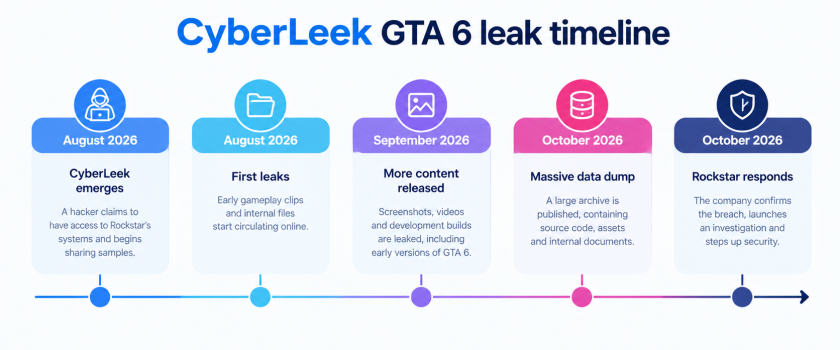
CyberLeek first appeared around 18 August 2026. The persona posted short GTA 6 gameplay clips and an image claiming to show the full map. Later releases grew longer. On 8 October, a file of roughly 25 minutes of footage appeared under the title “An Extended Leek.”
The persona also published a manifesto. It criticized digital-only game sales and monetization practices. The same persona promoted a cryptocurrency token and watermarked clips with it. That mix of protest and profit makes the motive unclear.
On the legal side, Take-Two filed DMCA subpoenas in a New York federal court. They targeted Microsoft and Discord. The filings ask for account details, IP addresses, and linked device information. Microsoft’s Xbox CTO said the company was working with Take-Two and Rockstar.
Treat all of this as reported information. Courts and the companies involved have not published a full account.
What is not known (and why guessing is risky)
Some websites claim to explain exactly how CyberLeek broke in. Be careful with those claims. As of this writing, no verified source describes the entry point.
Several reports mention a “playable build.” Fans also argue about whether the footage comes from an older build. Those points are rumors until Rockstar or a court filing confirms them.
A leak does not always mean a hack. Data can leave a company in at least four ways:
- An external attacker breaks in.
- A current or former employee copies files.
- A contractor or partner loses control of a copy.
- A misconfigured cloud service or repository exposes files.
Each cause needs a different fix. That is why a proper investigation matters more than a quick theory. Good incident response starts with evidence, not assumptions.
Lessons from the 2022 Rockstar breach
Rockstar has faced this before. In September 2022, an attacker posted dozens of early GTA 6 development videos online. Rockstar confirmed that an unauthorized third party accessed and downloaded confidential information.
The attacker reportedly claimed access to internal tools such as Slack and Confluence. Public reporting linked the person to the same social engineering style seen in an Uber breach days earlier. In that case, the attacker reportedly tricked a contractor and then pushed repeated MFA prompts until the victim approved one.
A UK court later dealt with the teenager linked to those attacks. He was a member of the Lapsus$ group. The case shows that one determined person, with no advanced malware, can cause enormous damage.
The key lesson is simple. Attackers often target people and access, not firewalls.
Why game studios are attractive targets
Unreleased games are valuable. Leaks create headlines, attract followers, and sometimes help sell cryptocurrency or stolen data.
Studios also share a lot of material. A single game involves artists, programmers, testers, translators, publishers, and platform partners. Every extra person and account widens the attack surface.
Large teams use many tools. Source control, chat, task trackers, build servers, cloud storage, and VPNs all hold sensitive data. One weak account in any of them can expose the rest.
Other industries face the same pattern. A hospital, a law firm, and an oil distributor all hold data that someone wants. The details change. The attack paths stay familiar.
Common techniques used to steal company data
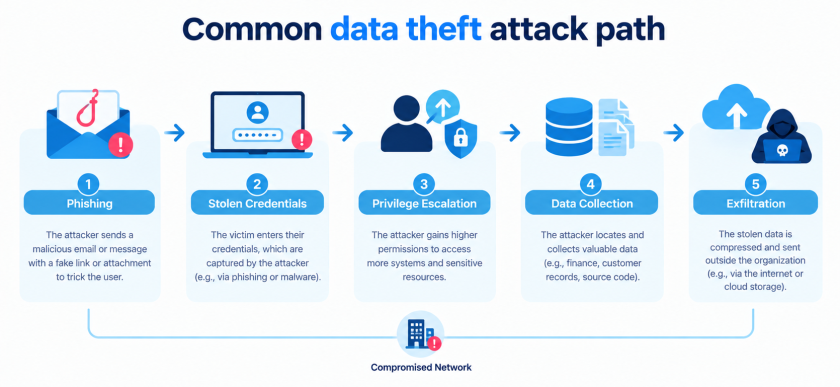
Security teams describe attacker behavior using the MITRE ATT&CK framework. It groups actions into stages, such as initial access, credential access, collection, and exfiltration. Below are the most common real-world patterns, explained at a defensive level.
Phishing and social engineering
Phishing tricks a person into giving up a password, approving a login, or running a file. Attackers also call or message staff while pretending to be IT support.
Social engineering works because it targets trust. A rushed employee may approve a request that looks routine. Training and clear verification rules reduce this risk.
Stolen and reused credentials
Many breaches start with a valid username and password. Attackers get them from earlier data leaks, phishing pages, or malware that steals saved browser logins. This malware is often called an infostealer.
People reuse passwords across work and personal accounts. When one site leaks, the attacker tries the same login elsewhere. This is called credential stuffing.
MFA fatigue
Some MFA systems send a push prompt to the user’s phone. An attacker with a stolen password can trigger prompt after prompt. A tired user may tap “Approve” just to stop the noise.
Number matching and phishing-resistant MFA, such as FIDO2 security keys, make this attack much harder.
Help desk and account recovery abuse
Attackers may call a help desk and claim to be a locked-out employee. If the agent resets the password or MFA method without strong checks, the attacker gains access. This weakness has been reported in several major incidents.
Third-party and contractor access
Companies often trust vendors more than they should. A contractor laptop, a shared account, or a partner portal can become the way in.
The 2022 Uber incident reportedly began with a contractor. The lesson is to apply the same security rules to outside users as to employees.
Exposed repositories and leaked secrets
Developers sometimes commit passwords, API keys, or tokens to code repositories. Public repositories are scanned constantly by automated tools. A leaked key can give direct access to cloud storage or internal systems.
Take-Two’s reported takedown notice to GitHub shows another side of this. Repositories can also be used to share leaked material after a theft.
Unpatched software and exposed services
Attackers scan the internet for servers with known vulnerabilities. A VPN gateway, file transfer tool, or web application that misses a patch can be an easy entry point.
Check the official advisory for each product and apply fixes quickly. Prioritize anything exposed to the internet.
Insider threats
An insider already has access. This person may be malicious, bribed, careless, or simply leaving for a competitor.
Insider risk is hard to see in logs because the activity looks legitimate. Behavior monitoring and strict access limits help the most.
Ransomware and double extortion
Many criminal groups now steal data first and then encrypt systems. They threaten to publish the data if the company refuses to pay. This is called double extortion.
A leak site run by such a group is a data theft channel in its own right. Backups alone do not solve this problem, because the stolen copy still exists.
How stolen data leaves the network
After attackers gain access, they look for valuable files. They copy them to a place they control. Security teams call this exfiltration.
Common channels include:
- Cloud storage services that look like normal business traffic.
- Web uploads over HTTPS, which hide the content from simple filters.
- Chat and collaboration platforms.
- Remote access tools already installed on the network.
- Removable drives or personal email, in insider cases.
Large transfers are not always obvious. Attackers may copy data slowly, compress it, or use legitimate tools to blend in.
This is why monitoring must focus on behavior. A developer account that suddenly downloads thousands of files at 3 a.m. deserves a look, even if the password was correct.
Defenses that work
No single tool stops every attack. The table below maps each threat to practical controls.
| Threat | Practical controls |
|---|---|
| Phishing and social engineering | Security awareness training, email filtering, reporting button, verification steps for sensitive requests |
| Stolen credentials | Unique passwords, password manager, phishing-resistant MFA, credential monitoring |
| MFA fatigue | Number matching, FIDO2 keys, alerts on repeated prompts |
| Help desk abuse | Identity verification script, manager approval for MFA resets, call-back checks |
| Third-party access | Separate vendor accounts, least privilege, time-limited access, regular reviews |
| Exposed secrets | Secret scanning in repositories, key rotation, short-lived tokens |
| Unpatched systems | Asset inventory, patch SLAs, vulnerability scanning, reduced internet exposure |
| Insider risk | Role-based access, activity logging, offboarding checklist, data loss prevention |
| Exfiltration | Egress filtering, DLP, anomaly alerts, restricted cloud uploads |
| Ransomware | Offline backups, network segmentation, endpoint detection, tested recovery |
Start with identity
Most modern attacks target identity. Enforce MFA on every remote access path, every admin account, and every cloud service. Prefer hardware keys for privileged users.
Remove old accounts. Disable access the day someone leaves.
Apply least privilege
Give each person only the access needed for their job. An artist does not need to download the whole source tree. A tester does not need production database access.
Review permissions every quarter. Access tends to grow over time and rarely shrinks on its own.
Segment the network
Separate build servers, source control, and file shares from the general office network. If an attacker compromises one laptop, segmentation limits how far they can go.
Log and watch
Collect logs from identity providers, VPNs, cloud platforms, source control, and endpoints. Send them to a central system, such as a SIEM. Write alerts for unusual downloads, impossible travel, and new admin accounts.
Logs only help if someone reads them. Smaller teams can use a managed detection service.
Protecting pre-release builds and source code
Leaks of unreleased software need extra controls.
- Limit who can access full builds. Most staff need only the part they work on.
- Use build watermarking. Unique markers per recipient help trace which copy leaked.
- Control distribution to partners. Use access-controlled portals with expiry dates, not email attachments.
- Restrict devices. Require managed, encrypted machines for sensitive work.
- Block unapproved uploads. Restrict cloud storage, personal email, and file sharing from work devices.
- Scan repositories. Detect secrets and unexpected large files before they spread.
- Plan for takedowns. Prepare DMCA notices and contacts at major platforms in advance.
Reports mention that Rockstar already requires staff to work on-site on sensitive projects. That helps, but it is not a guarantee. A determined insider or a compromised account can still move data.
What to do if you suspect a breach
Speed matters. Follow a clear order.
- Contain the problem. Disable affected accounts and isolate suspicious machines. Do not wipe systems yet, because you need evidence.
- Preserve logs. Save identity, VPN, cloud, and endpoint logs before they rotate.
- Reset credentials. Change passwords and revoke sessions and API tokens for affected users.
- Find the entry point. Review authentication logs for unusual logins, new devices, and MFA events.
- Measure the impact. Identify which systems and data were accessed.
- Notify the right people. Involve legal counsel, management, and regulators when required. Many laws set strict notification deadlines.
- Fix the root cause. Patch, tighten access, and close the gap.
- Review and improve. Write a post-incident report and update your plan.
If you do not have an internal security team, call a qualified incident response provider early.
A practical checklist for small and mid-size companies
You do not need a game studio’s budget to reduce risk. Start here:
- Turn on MFA everywhere, starting with email and admin accounts.
- Use a password manager for the whole team.
- Keep an inventory of devices, servers, and cloud services.
- Patch internet-facing systems first.
- Back up critical data and store one copy offline.
- Remove unused accounts and review admin rights.
- Train staff on phishing and phone-based scams.
- Write a one-page incident plan with phone numbers.
- Test restoring a backup at least twice a year.
These steps stop a large share of common attacks.
FAQ
Who is CyberLeek?
CyberLeek is an anonymous persona that has posted unreleased GTA 6 material since August 2026. Take-Two has pursued legal action to identify those responsible. No verified identity has been made public.
How did CyberLeek leak GTA 6?
There is no publicly confirmed explanation. Reports say the persona may have a playable build, but the method of access is unverified. Any specific claim about the break-in should be treated as speculation.
Was this the same attacker as the 2022 leak?
There is no evidence of that in public reporting. The 2022 attacker was separately identified and prosecuted in the UK.
What techniques do hackers use to steal data from companies?
The most common are phishing, social engineering, stolen credentials, MFA fatigue, third-party access abuse, exposed secrets, unpatched software, insider misuse, and ransomware with data theft.
Can a leak happen without a hack?
Yes. A careless employee, a contractor, or a misconfigured cloud service can expose data without any outside attacker.
Is it legal to download or share leaked game builds?
Often it is not. Leaked material is usually protected by copyright, and distribution can trigger takedowns and legal action. Leaked files may also carry malware.
What is the best single control against data theft?
Phishing-resistant MFA on all accounts gives the biggest improvement for most companies. It does not replace the other controls, but it blocks many common attacks.
How can a small business protect itself?
Use MFA, keep systems patched, limit access, back up data, and train staff. Add monitoring as you grow.
Conclusion
The CyberLeek case is still developing, and the entry point remains unknown. Waiting for that answer is not necessary to learn from it. The record from Rockstar’s 2022 breach and many other incidents points to the same weak spots: people, credentials, and over-broad access.
Protect identity first. Limit what each account can reach. Watch for abnormal behavior. Rehearse your response before you need it.
Want more articles and tutorials like this?
Get new tutorials, security alerts, and IT tips straight to your inbox.